
Tu historia importa: análisis del discurso emocional en textos en inglés de pacientes sobre salud mental
DOI:
https://doi.org/10.4151/S0718-09342026012001389Palabras clave:
lingüística de corpus, emociones, salud mental, pacientes, análisis de sentimientoResumen
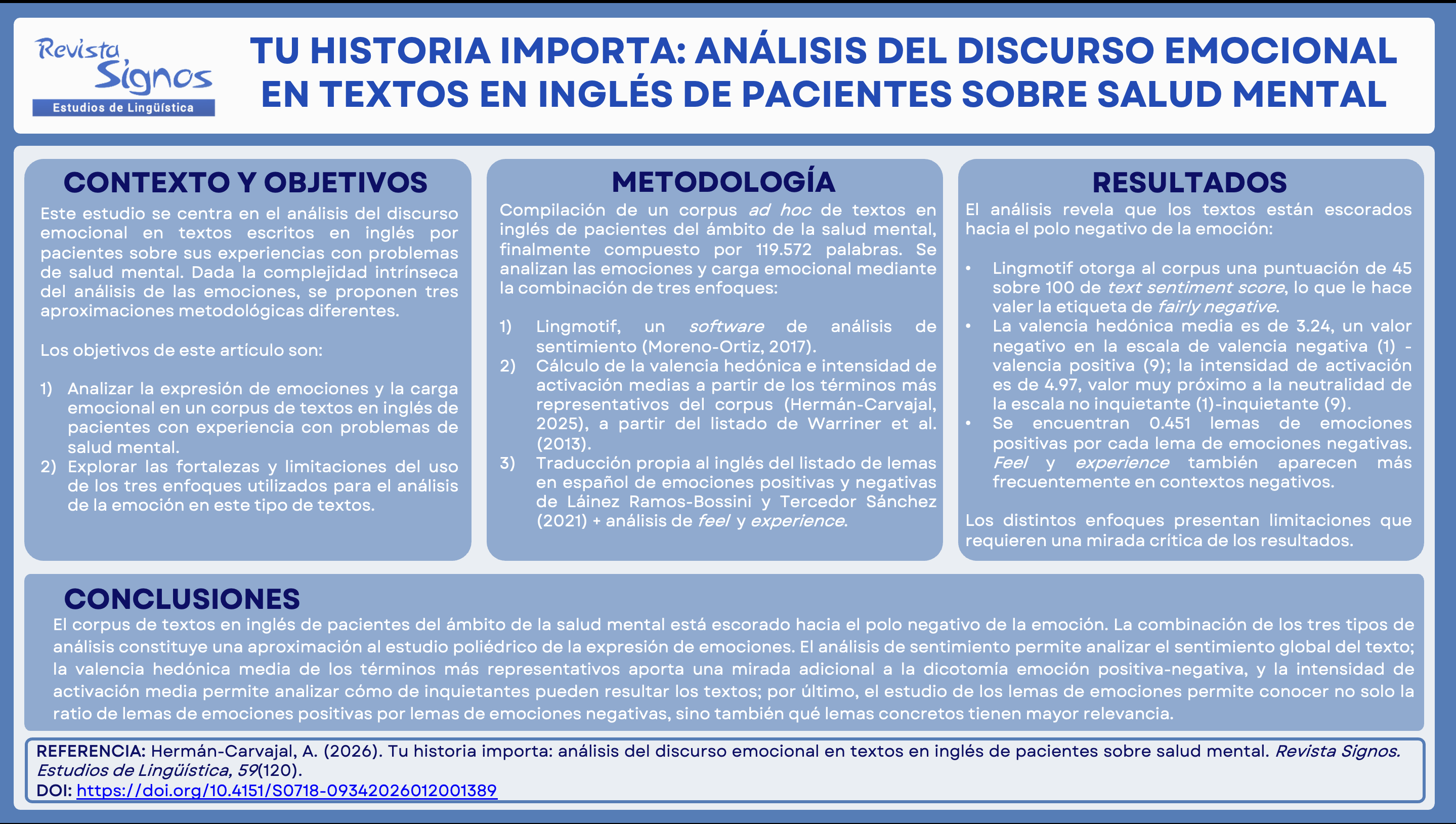
La salud mental puede resultar, a veces, un tema tabú, aunque el debate público al respecto ha ido en aumento recientemente. Este estudio se centra en el análisis del discurso emocional de textos escritos en inglés por pacientes sobre sus experiencias con problemas de salud mental. Este artículo presenta dos objetivos: analizar la expresión de emociones y la carga emocional en textos escritos en lengua inglesa por parte de pacientes con problemas de salud mental y explorar las fortalezas y limitaciones que presentan las herramientas y enfoques utilizados para el análisis de este tipo de textos. Para cumplir estos objetivos, se ha compilado un corpus de textos en inglés y se ha analizado su carga emocional mediante tres enfoques: (1) Lingmotif (Moreno-Ortiz, 2017), una herramienta de análisis de sentimiento; (2) la propuesta para el análisis de lemas según valencia hedónica e intensidad de activación de de Hermán-Carvajal (2025); y (3) la metodología de Láinez Ramos-Bossini y Tercedor Sánchez (2021) sobre valencia hedónica en términos emocionales. Los resultados indican que el discurso emocional en estos textos muestra una leve tendencia negativa y revelan cómo los distintos métodos de análisis utilizados se complementan.
Citas
Charland, L. C. (2005). Emotion experience and the indeterminacy of valence. En L. F. Barrett, P. M. Niedenthal, & P. Winkielman (Eds.), Emotion and consciousness (pp. 231-254). The Guilford Press.
Citron, F. M. M. (2012). Neural correlates of written emotion word processing: A review of recent electrophysiological and hemodynamic neuroimaging studies. Brain and Language, 122(3), 211-226. https://doi.org/10.1016/j.bandl.2011.12.007
Cotrufo, T., & Ureña Bares, J. M. (2018). El cerebro y las emociones. Sentir, pensar, decidir. EMSE EDAPP, S.L.
Díaz, J. L., & Flores, E. O. (2001). La estructura de la emoción humana: un modelo cromático del sistema afectivo. Salud mental, 24(4), 20-35. https://www.redalyc.org/articulo.oa?id=58242403
Fernández Jaén, J. (2016). Usos modales y epistémicos del verbo sentir. Revista de Investigación Lingüística, 19, 199-226. https://revistas.um.es/ril/article/view/283581
Hermán-Carvajal, A. (2024). La expresión de emociones en el acceso de los jóvenes al conocimiento científico sobre salud mental: análisis contrastivo inglés-español [Tesis doctoral]. Universidad de Granada.
Hermán-Carvajal, A. (2025). Emotion as tourist appeal: a contrastive English-Spanish analysis of slow tourism and adventure tourism discourse from an emotional perspective. En M. Álvarez Jurado, & G. Policastro Ponce (Eds.), Nuevos enfoques lingüísticos y traductológicos del discurso turístico (pp. 15-21). John Benjamins. https://doi.org/10.1075/ivitra.44.02her
Hermán-Carvajal, A., & Tercedor Sánchez, M. (2022). Textos audiovisuales sobre salud para adolescentes y jóvenes adultos: análisis de estrategias lingüísticas aplicadas a través del uso de elementos emocionales. Panace@, 23(56), 41-55. https://doi.org/10.5281/zenodo.7701063
Hermán-Carvajal, A., & Humánez-Berral, P. (2024). Análisis de la carga emocional para la traducción y adaptación inglés-español de textos sobre salud. En C. Rodríguez Faneca (Ed.), La traducción y la interpretación desde y hacia el Mediterráneo (pp. 83-91). Comares.
Joffily, M., & Coricelli, G. (2013). Emotional Valence and the Free-Energy Principle. PLoS Computational Biology, 9(6), e1003094. https://doi.org/10.1371/journal.pcbi.1003094
Kensinger, E. A. (2004). Remembering Emotional Experiences: The Contribution of Valence and Arousal. Reviews in the Neurosciences, 15(4). https://doi.org/10.1515/REVNEURO.2004.15.4.241
Kilgarriff, A., Rychly, P., Smrz, P., & Tugwell, A. (2004). The Sketch Engine. Information Technology Research Institute Technical Report Series, ITRI-04-08.
Kilgarriff, A., Baisa, V., Bušta, J., Jakubíček, M., Kovář, V., Michelfeit, J., Rychlý, P., & Suchomel, V. (2014). The Sketch Engine: ten years on. Lexicography, 1(1), 7-36. https://doi.org/10.1007/s40607-014-0009-9
Kousta, S. T., Vinson, D. P., & Vigliocco, G. (2009). Emotion words, regardless of polarity, have a processing advantage over neutral words. Cognition, 112(3), 473-481. https://doi.org/10.1016/j.cognition.2009.06.007
Láinez Ramos-Bossini, A. J., & Tercedor Sánchez, M. (2021). Lenguaje y emoción: estudio basado en corpus de foros de debate sobre salud mental. En S. A. Flores Borjabad, & T. Pérez Cabaña (Eds.), Nuevos retos y perspectivas de la investigación en Literatura, Lingüística y Traducción (pp. 1712-1737). Dykinson.
Lévai, T., Lázár, G., Krajinovic, E., Devosa, I., & Látos, M. (2024). Examining illness narratives in the context of the postoperative psychological state: A mixed-methods study of emotion-focused illness narrative. BioPsychoSocial Medicine, 18(1), 1-16. https://doi.org/10.1186/s13030-024-00318-4
López-Rodríguez, C. I., & Tercedor Sánchez, M. (2022). Caracterización léxico-semántica de emociones para la comunicación interlingüística inglés-español. Pragmalinguistica, 30. https://doi.org/10.25267/Pragmalinguistica.2022.i30.12
Ministerio de Sanidad. (2022). Plan de Acción de Salud Mental 2022-2024. https://www.sanidad.gob.es/areas/calidadAsistencial/estrategias/saludMental/docs/PLAN_ACCION_SALUD_MENTAL_2022-2024.pdf
Mohammad, S., Shutova, E., & Turney, P. (2016). Metaphor as a medium for emotion: an empirical study. Proceedings of the fifth joint conference on lexical and computational semantics, 23-33. https://doi.org/10.18653/v1/S16-2003
Moreno-Ortiz, A. (2017). Lingmotif: A user-focused sentiment analysis tool. Procesamiento del Lenguaje Natural, 58, 133-140. http://journal.sepln.org/sepln/ojs/ojs/index.php/pln/article/view/5422
Muñoz-del-Pino, I. M., Matías-García, J. A., & Saavedra-Macías, F. J. (2025). A Systematic Review of the Use of Blogs and Vlogs as Self-Expressors for People with Serious and Common Mental Illness. Psychiatric Quarterly. https://doi.org/10.1007/s11126-025-10158-2
Niu, X., Taylor, M. M., Wicks, J. J., Fassett-Carman, A. N., Moser, A. D., Neilson, C., Peterson, E. C., Kaiser, R. H., & Snyder, H. R. (2023). Longitudinal relations between emotion regulation and internalizing symptoms in emerging adults during the Covid-19 pandemic. Cognitive Therapy and Research, 47(3), 350-366. https://doi.org/10.1007/s10608-023-10366-9
Organización Mundial de la Salud. (2022). World mental health report: Transforming mental health for all. https://iris.who.int/server/api/core/bitstreams/40e5a13a-fe50-4efa-b56d-6e8cf00d5bfa/content
Pastuszak-Draxler, A., & Gierowski, J. K. (2017). Changes in acceptance and suppression of negative and positive emotions in patients with depressive disorders: a longitudinal study. Archives of Psychiatry and Psychotherapy, 19(4), 13-21. https://doi.org/10.12740/APP/80161
Perkins, M. (1966). Emotion and feeling. The Philosophical Review, 75(2), 139. https://doi.org/10.2307/2183081
Pinheiro, P., Gonçalves, M. M., Sousa, I., & Salgado, J. (2021). What is the effect of emotional processing on depression? A longitudinal study. Psychotherapy Research, 31(4), 507-519. https://doi.org/10.1080/10503307.2020.1781951
Plutchik, R. (2001). The nature of emotions. American Scientist, 89(4), 344-350. https://doi.org/10.1511/2001.28.344
Stadthagen-Gonzalez, H., Imbault, C., Pérez Sánchez, M. A., & Brysbaert, M. (2017). Norms of valence and arousal for 14,031 Spanish words. Behavior Research Methods, 49(1), 111-123. https://doi.org/10.3758/s13428-015-0700-2
Timmer-Murillo, S., Schramm, A. T., Geier, T. J., Mcleod, E., Larson, C. L., & deRoon-Cassini, T. A. (2023). Facets of emotion dysregulation differentially predict depression and PTSD symptom severity following traumatic injury. European Journal of Psychotraumatology, 14(2). https://doi.org/10.1080/20008066.2023.2193524
Um, E. Rachel, Plass, J. L., Hayward, E. O., & Homer, B. D. (2012). Emotional design in multimedia learning. Journal of Educational Psychology, 104(2), 485-498. https://doi.org/10.1037/a0026609
Warriner, A. B., Kuperman, V., & Brysbaert, M. (2013). Norms of valence, arousal, and dominance for 13,915 English lemmas. Behavior Research Methods, 45(4), 1191-1207. https://doi.org/10.3758/s13428-012-0314-x
Yang, Y., Wang, J., Lin, H., Chen, X., Chen, Y., Kuang, J., Yao, Y., Wang, T., & Fu, C. (2025). Emotion dynamics prospectively predict depressive symptoms in adolescents: findings from intensive longitudinal data. BMC Psychology, 13(1), 386. https://doi.org/10.1186/s40359-025-02699-9
Zhang, Z., & Huang, Q. (2025). Between support and strain: How do the illness narratives of patients with mental issues articulate the affordances of smartphones? Digital Health, 11. https://doi.org/10.1177/20552076251360882
Publicado
Cómo citar
Número
Sección
Licencia
Derechos de autor 2026 Revista Signos. Estudios de Lingüística

Esta obra está bajo una licencia internacional Creative Commons Atribución 4.0.
Aquellos autores que tengan publicaciones con esta revista, aceptan los términos siguientes:
- Los autores conservarán sus derechos de autor y garantizarán a la revista el derecho de primera publicación de su obra por medio de este documento de cesión de derechos de autoría, el cuál estará simultáneamente sujeto a la licencia de reconocimiento de Creative Commons que permite a terceros compartir la obra siempre que se indique su autor y su primera publicación esta revista.
- Los autores podrán adoptar otros acuerdos de licencia no exclusiva de distribución de la versión de la obra publicada (p. ej.: depositarla en un repositorio institucional o publicarla en un volumen monográfico) siempre que se indique la publicación inicial en esta revista.
- Se permite y recomienda a los autores difundir su obra a través de Internet (p. ej.: en publicaciones institucionales o en su página web) antes y durante el proceso de envío, lo cual puede producir intercambios interesantes y aumentar las citas de la obra publicada. (Véase el efecto del acceso abierto).