
Your Story Matters: Analysis of Emotional Discourse in Patient-Produced Mental Health Texts in English
DOI:
https://doi.org/10.4151/S0718-09342026012001389Keywords:
corpus linguistics, emotions, mental health, patients, sentiment analysisAbstract
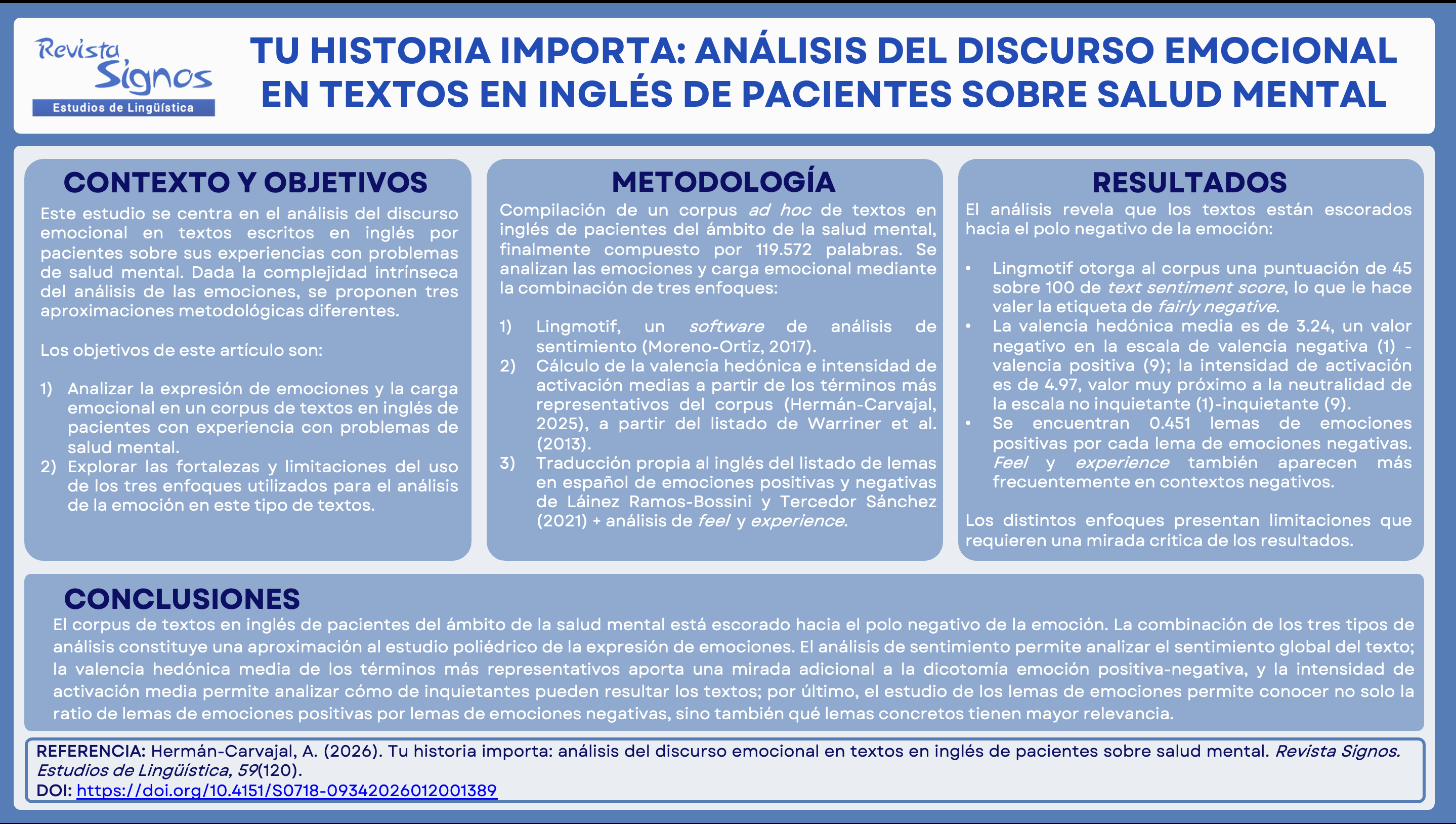
Mental health can sometimes be a taboo topic, although public debate on the subject has recently increased. This study focuses on the analysis of emotional discourse in English-language texts written by patients about their experiences with mental health issues. This paper has two main objectives: to analyze the expression of emotions and emotional load in texts written in English by patients with mental health problems and to explore the strengths and limitations of the tools and approaches used for analyzing this type of text. To achieve these objectives, an English-language text corpus was compiled and analyzed using three approaches: (1) Lingmotif (Moreno-Ortiz, 2017), a sentiment analysis tool; (2) the proposal by Hermán-Carvajal (2025) for lemma analysis based on hedonic valence and activation intensity; and (3) the methodology by Láinez Ramos-Bossini and Tercedor Sánchez (2021) on hedonic valence in emotional terms. The results indicate that the emotional discourse in these texts shows a slight negative tendency and reveal how the different analysis methods complement each other.
References
Charland, L. C. (2005). Emotion experience and the indeterminacy of valence. En L. F. Barrett, P. M. Niedenthal, & P. Winkielman (Eds.), Emotion and consciousness (pp. 231-254). The Guilford Press.
Citron, F. M. M. (2012). Neural correlates of written emotion word processing: A review of recent electrophysiological and hemodynamic neuroimaging studies. Brain and Language, 122(3), 211-226. https://doi.org/10.1016/j.bandl.2011.12.007
Cotrufo, T., & Ureña Bares, J. M. (2018). El cerebro y las emociones. Sentir, pensar, decidir. EMSE EDAPP, S.L.
Díaz, J. L., & Flores, E. O. (2001). La estructura de la emoción humana: un modelo cromático del sistema afectivo. Salud mental, 24(4), 20-35. https://www.redalyc.org/articulo.oa?id=58242403
Fernández Jaén, J. (2016). Usos modales y epistémicos del verbo sentir. Revista de Investigación Lingüística, 19, 199-226. https://revistas.um.es/ril/article/view/283581
Hermán-Carvajal, A. (2024). La expresión de emociones en el acceso de los jóvenes al conocimiento científico sobre salud mental: análisis contrastivo inglés-español [Tesis doctoral]. Universidad de Granada.
Hermán-Carvajal, A. (2025). Emotion as tourist appeal: a contrastive English-Spanish analysis of slow tourism and adventure tourism discourse from an emotional perspective. En M. Álvarez Jurado, & G. Policastro Ponce (Eds.), Nuevos enfoques lingüísticos y traductológicos del discurso turístico (pp. 15-21). John Benjamins. https://doi.org/10.1075/ivitra.44.02her
Hermán-Carvajal, A., & Tercedor Sánchez, M. (2022). Textos audiovisuales sobre salud para adolescentes y jóvenes adultos: análisis de estrategias lingüísticas aplicadas a través del uso de elementos emocionales. Panace@, 23(56), 41-55. https://doi.org/10.5281/zenodo.7701063
Hermán-Carvajal, A., & Humánez-Berral, P. (2024). Análisis de la carga emocional para la traducción y adaptación inglés-español de textos sobre salud. En C. Rodríguez Faneca (Ed.), La traducción y la interpretación desde y hacia el Mediterráneo (pp. 83-91). Comares.
Joffily, M., & Coricelli, G. (2013). Emotional Valence and the Free-Energy Principle. PLoS Computational Biology, 9(6), e1003094. https://doi.org/10.1371/journal.pcbi.1003094
Kensinger, E. A. (2004). Remembering Emotional Experiences: The Contribution of Valence and Arousal. Reviews in the Neurosciences, 15(4). https://doi.org/10.1515/REVNEURO.2004.15.4.241
Kilgarriff, A., Rychly, P., Smrz, P., & Tugwell, A. (2004). The Sketch Engine. Information Technology Research Institute Technical Report Series, ITRI-04-08.
Kilgarriff, A., Baisa, V., Bušta, J., Jakubíček, M., Kovář, V., Michelfeit, J., Rychlý, P., & Suchomel, V. (2014). The Sketch Engine: ten years on. Lexicography, 1(1), 7-36. https://doi.org/10.1007/s40607-014-0009-9
Kousta, S. T., Vinson, D. P., & Vigliocco, G. (2009). Emotion words, regardless of polarity, have a processing advantage over neutral words. Cognition, 112(3), 473-481. https://doi.org/10.1016/j.cognition.2009.06.007
Láinez Ramos-Bossini, A. J., & Tercedor Sánchez, M. (2021). Lenguaje y emoción: estudio basado en corpus de foros de debate sobre salud mental. En S. A. Flores Borjabad, & T. Pérez Cabaña (Eds.), Nuevos retos y perspectivas de la investigación en Literatura, Lingüística y Traducción (pp. 1712-1737). Dykinson.
Lévai, T., Lázár, G., Krajinovic, E., Devosa, I., & Látos, M. (2024). Examining illness narratives in the context of the postoperative psychological state: A mixed-methods study of emotion-focused illness narrative. BioPsychoSocial Medicine, 18(1), 1-16. https://doi.org/10.1186/s13030-024-00318-4
López-Rodríguez, C. I., & Tercedor Sánchez, M. (2022). Caracterización léxico-semántica de emociones para la comunicación interlingüística inglés-español. Pragmalinguistica, 30. https://doi.org/10.25267/Pragmalinguistica.2022.i30.12
Ministerio de Sanidad. (2022). Plan de Acción de Salud Mental 2022-2024. https://www.sanidad.gob.es/areas/calidadAsistencial/estrategias/saludMental/docs/PLAN_ACCION_SALUD_MENTAL_2022-2024.pdf
Mohammad, S., Shutova, E., & Turney, P. (2016). Metaphor as a medium for emotion: an empirical study. Proceedings of the fifth joint conference on lexical and computational semantics, 23-33. https://doi.org/10.18653/v1/S16-2003
Moreno-Ortiz, A. (2017). Lingmotif: A user-focused sentiment analysis tool. Procesamiento del Lenguaje Natural, 58, 133-140. http://journal.sepln.org/sepln/ojs/ojs/index.php/pln/article/view/5422
Muñoz-del-Pino, I. M., Matías-García, J. A., & Saavedra-Macías, F. J. (2025). A Systematic Review of the Use of Blogs and Vlogs as Self-Expressors for People with Serious and Common Mental Illness. Psychiatric Quarterly. https://doi.org/10.1007/s11126-025-10158-2
Niu, X., Taylor, M. M., Wicks, J. J., Fassett-Carman, A. N., Moser, A. D., Neilson, C., Peterson, E. C., Kaiser, R. H., & Snyder, H. R. (2023). Longitudinal relations between emotion regulation and internalizing symptoms in emerging adults during the Covid-19 pandemic. Cognitive Therapy and Research, 47(3), 350-366. https://doi.org/10.1007/s10608-023-10366-9
Organización Mundial de la Salud. (2022). World mental health report: Transforming mental health for all. https://iris.who.int/server/api/core/bitstreams/40e5a13a-fe50-4efa-b56d-6e8cf00d5bfa/content
Pastuszak-Draxler, A., & Gierowski, J. K. (2017). Changes in acceptance and suppression of negative and positive emotions in patients with depressive disorders: a longitudinal study. Archives of Psychiatry and Psychotherapy, 19(4), 13-21. https://doi.org/10.12740/APP/80161
Perkins, M. (1966). Emotion and feeling. The Philosophical Review, 75(2), 139. https://doi.org/10.2307/2183081
Pinheiro, P., Gonçalves, M. M., Sousa, I., & Salgado, J. (2021). What is the effect of emotional processing on depression? A longitudinal study. Psychotherapy Research, 31(4), 507-519. https://doi.org/10.1080/10503307.2020.1781951
Plutchik, R. (2001). The nature of emotions. American Scientist, 89(4), 344-350. https://doi.org/10.1511/2001.28.344
Stadthagen-Gonzalez, H., Imbault, C., Pérez Sánchez, M. A., & Brysbaert, M. (2017). Norms of valence and arousal for 14,031 Spanish words. Behavior Research Methods, 49(1), 111-123. https://doi.org/10.3758/s13428-015-0700-2
Timmer-Murillo, S., Schramm, A. T., Geier, T. J., Mcleod, E., Larson, C. L., & deRoon-Cassini, T. A. (2023). Facets of emotion dysregulation differentially predict depression and PTSD symptom severity following traumatic injury. European Journal of Psychotraumatology, 14(2). https://doi.org/10.1080/20008066.2023.2193524
Um, E. Rachel, Plass, J. L., Hayward, E. O., & Homer, B. D. (2012). Emotional design in multimedia learning. Journal of Educational Psychology, 104(2), 485-498. https://doi.org/10.1037/a0026609
Warriner, A. B., Kuperman, V., & Brysbaert, M. (2013). Norms of valence, arousal, and dominance for 13,915 English lemmas. Behavior Research Methods, 45(4), 1191-1207. https://doi.org/10.3758/s13428-012-0314-x
Yang, Y., Wang, J., Lin, H., Chen, X., Chen, Y., Kuang, J., Yao, Y., Wang, T., & Fu, C. (2025). Emotion dynamics prospectively predict depressive symptoms in adolescents: findings from intensive longitudinal data. BMC Psychology, 13(1), 386. https://doi.org/10.1186/s40359-025-02699-9
Zhang, Z., & Huang, Q. (2025). Between support and strain: How do the illness narratives of patients with mental issues articulate the affordances of smartphones? Digital Health, 11. https://doi.org/10.1177/20552076251360882
Published
How to Cite
Issue
Section
License
Copyright (c) 2026 Revista Signos. Estudios de Lingüística

This work is licensed under a Creative Commons Attribution 4.0 International License.
Copyright agreement:
Authors who have a manuscript accepted for publication in this journal agree to the following terms:
Authors will retain their copyright and grant the journal the right of first publication of their work by means of this copyright agreement document, which is subject to the Creative Commons Acknowledgment License that allows third parties to share the work provided that its author and first publication in this journal are indicated.
Authors may adopt other non-exclusive license agreements for distribution of the published version of the work (e.g., depositing it in an institutional repository or publishing it in a monographic volume) as long as the initial publication in this journal is indicated.
Authors are allowed and encouraged to disseminate their work via the internet (e.g., in institutional publications or on their website) before and during the submission process, which can lead to interesting exchanges and increase citations of the published work (read more here).