
The Phenomenon of Usted as a Mitigation Strategy in Requests Towards Mother in the Spanish of Medellín (Colombia)
DOI:
https://doi.org/10.4151/S0718-09342026012001243Abstract
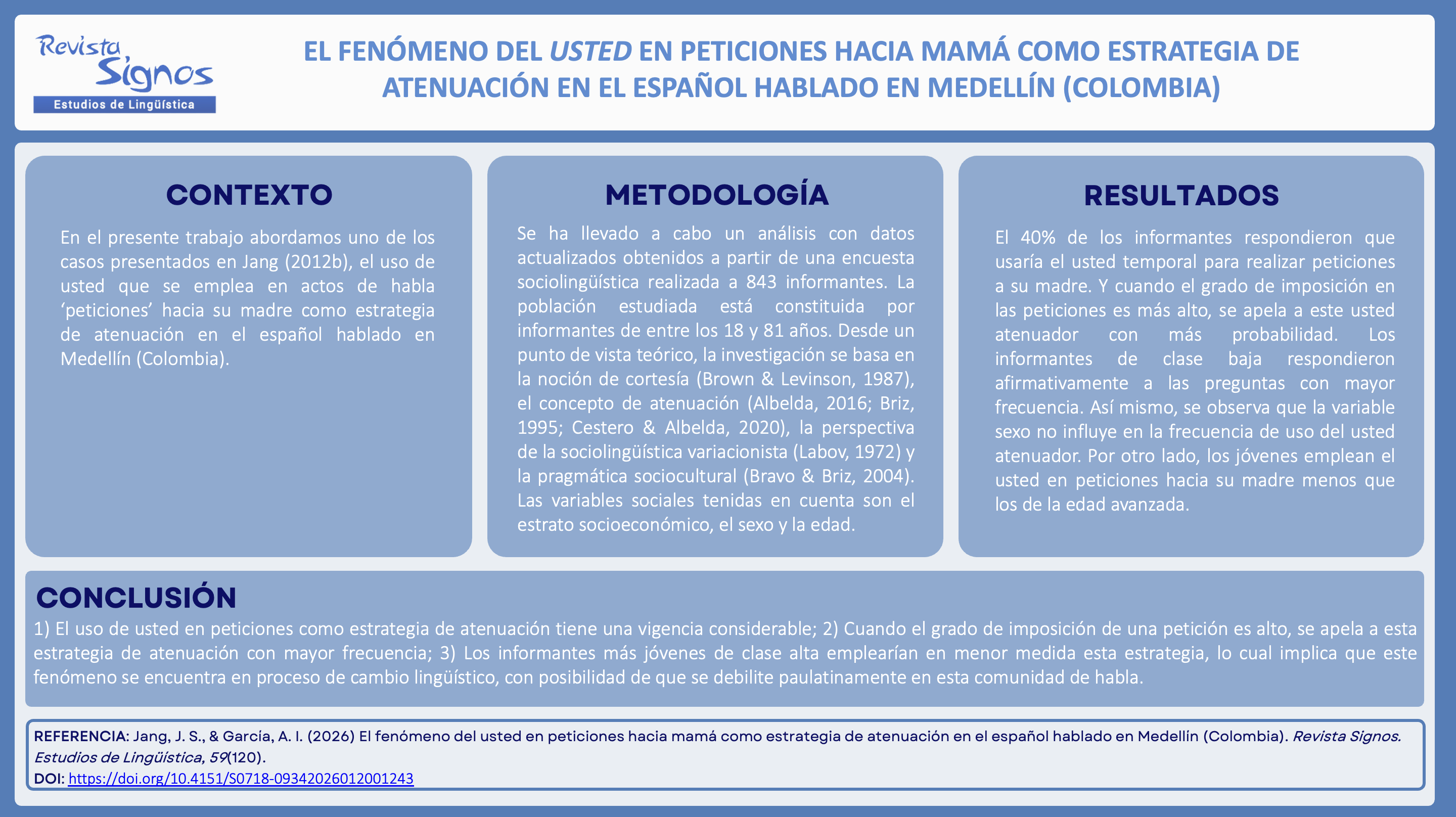
In this article, we study the use of usted as a mitigation strategy in requests towards one’s mother in Medellin Spanish (Jang, 2012b). We conducted an analysis with data from a sociolinguistic survey of 843 informants aged between 18 and 81 years. From a theoretical perspective, the research relied on the notion of politeness (Brown & Levinson, 1987), the concept of mitigation (Briz, 1995; Albelda, 2016; Cestero & Albelda, 2020), variationist sociolinguistics (Labov, 1972), and sociocultural pragmatics (Bravo & Briz, 2004). The social variables considered are socioeconomic status, sex, and age. Our conclusions include the following aspects: 1) the usted in requests as a mitigation strategy has considerable validity; 2) when the absolute ranking of imposition of a request is high, this mitigation strategy is used more frequently; 3) the younger upper-class informants would use this strategy to a lesser extent, which implies that this phenomenon is on the path of linguistic change, with the possibility of gradually weakening in this speech community.
Published
How to Cite
Issue
Section
License
Copyright (c) 2026 Revista Signos. Estudios de Lingüística

This work is licensed under a Creative Commons Attribution 4.0 International License.
Copyright agreement:
Authors who have a manuscript accepted for publication in this journal agree to the following terms:
Authors will retain their copyright and grant the journal the right of first publication of their work by means of this copyright agreement document, which is subject to the Creative Commons Acknowledgment License that allows third parties to share the work provided that its author and first publication in this journal are indicated.
Authors may adopt other non-exclusive license agreements for distribution of the published version of the work (e.g., depositing it in an institutional repository or publishing it in a monographic volume) as long as the initial publication in this journal is indicated.
Authors are allowed and encouraged to disseminate their work via the internet (e.g., in institutional publications or on their website) before and during the submission process, which can lead to interesting exchanges and increase citations of the published work (read more here).