
El impacto de la inteligencia emocional de rasgo y del disfrute sobre la competencia lectora en aprendices chinos de ELE
DOI:
https://doi.org/10.4151/S0718-09342026012001269Abstract
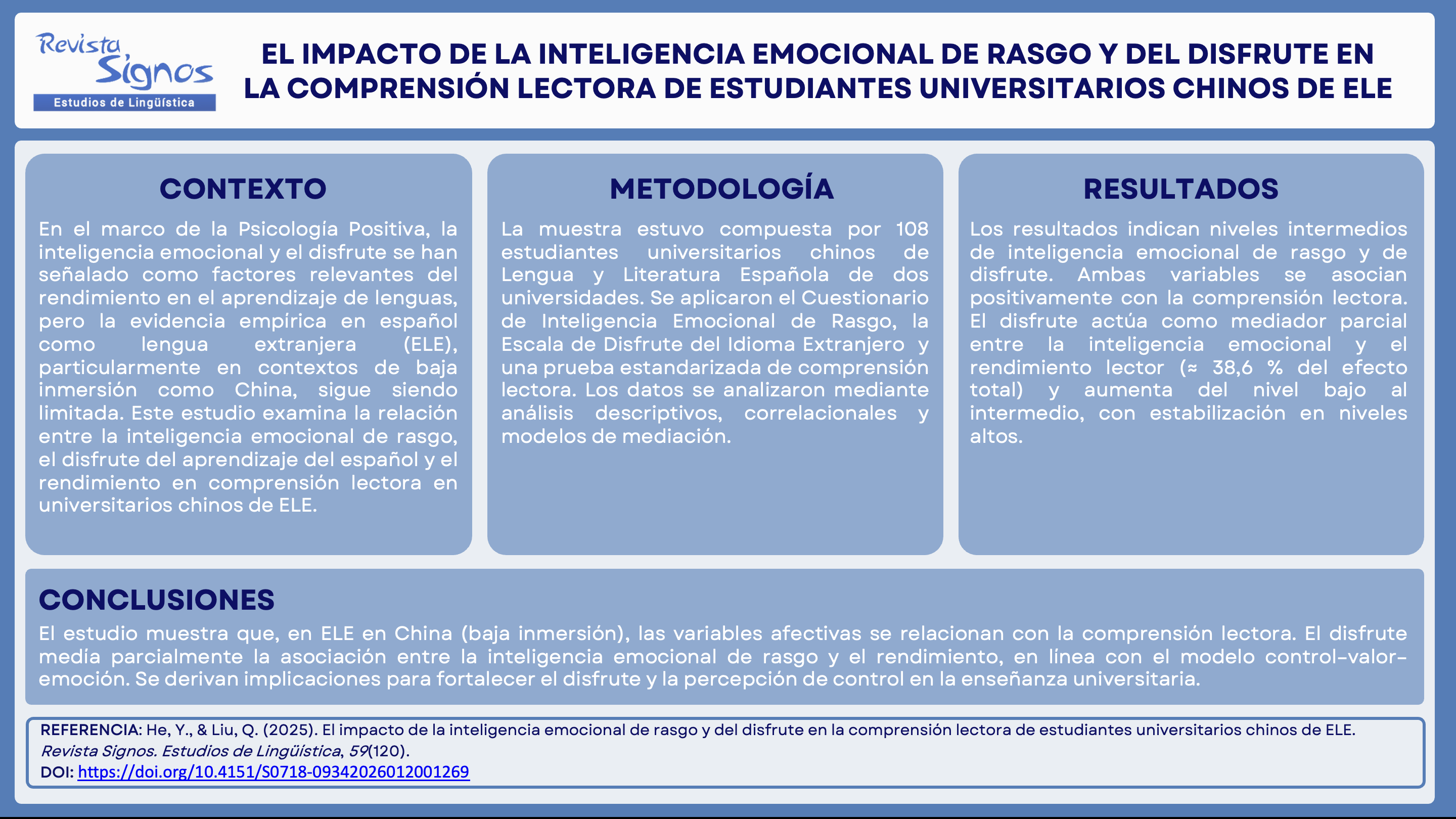
This study examines how trait emotional intelligence and foreign language enjoyment impact reading proficiency in Chinese students learning Spanish as a second language, within the framework of Positive Psychology. Data from 108 university students in southern China were quantitatively analyzed to assess the influence of affective factors on reading competence. Findings indicate that both trait emotional intelligence and enjoyment are at moderate levels, which are associated with generally positive educational experiences. Through correlation analysis, a significant relationship was established between higher emotional intelligence and superior academic performance. Furthermore, enjoyment was found to be a significant mediator in this relationship, suggesting its crucial role not only in enriching the learning experience but also in contributing to academic success. These findings emphasize the need for pedagogical strategies that foster emotional well-being and enjoyment, suggesting a more holistic and emotionally aware educational approach to enhance reading proficiency in Spanish language teaching.
Published
How to Cite
Issue
Section
License
Copyright (c) 2026 Revista Signos. Estudios de Lingüística

This work is licensed under a Creative Commons Attribution 4.0 International License.
Copyright agreement:
Authors who have a manuscript accepted for publication in this journal agree to the following terms:
Authors will retain their copyright and grant the journal the right of first publication of their work by means of this copyright agreement document, which is subject to the Creative Commons Acknowledgment License that allows third parties to share the work provided that its author and first publication in this journal are indicated.
Authors may adopt other non-exclusive license agreements for distribution of the published version of the work (e.g., depositing it in an institutional repository or publishing it in a monographic volume) as long as the initial publication in this journal is indicated.
Authors are allowed and encouraged to disseminate their work via the internet (e.g., in institutional publications or on their website) before and during the submission process, which can lead to interesting exchanges and increase citations of the published work (read more here).