
Relaciones entre intensificación y polaridad: el caso de la perífrasis <ʻcagarseʼ + gerundio> y la negación
DOI:
https://doi.org/10.4151/S0718-09342025011901276Palabras clave:
perífrasis verbal, intensificación, término de polaridad positiva, evento negativo, negación oracionalResumen
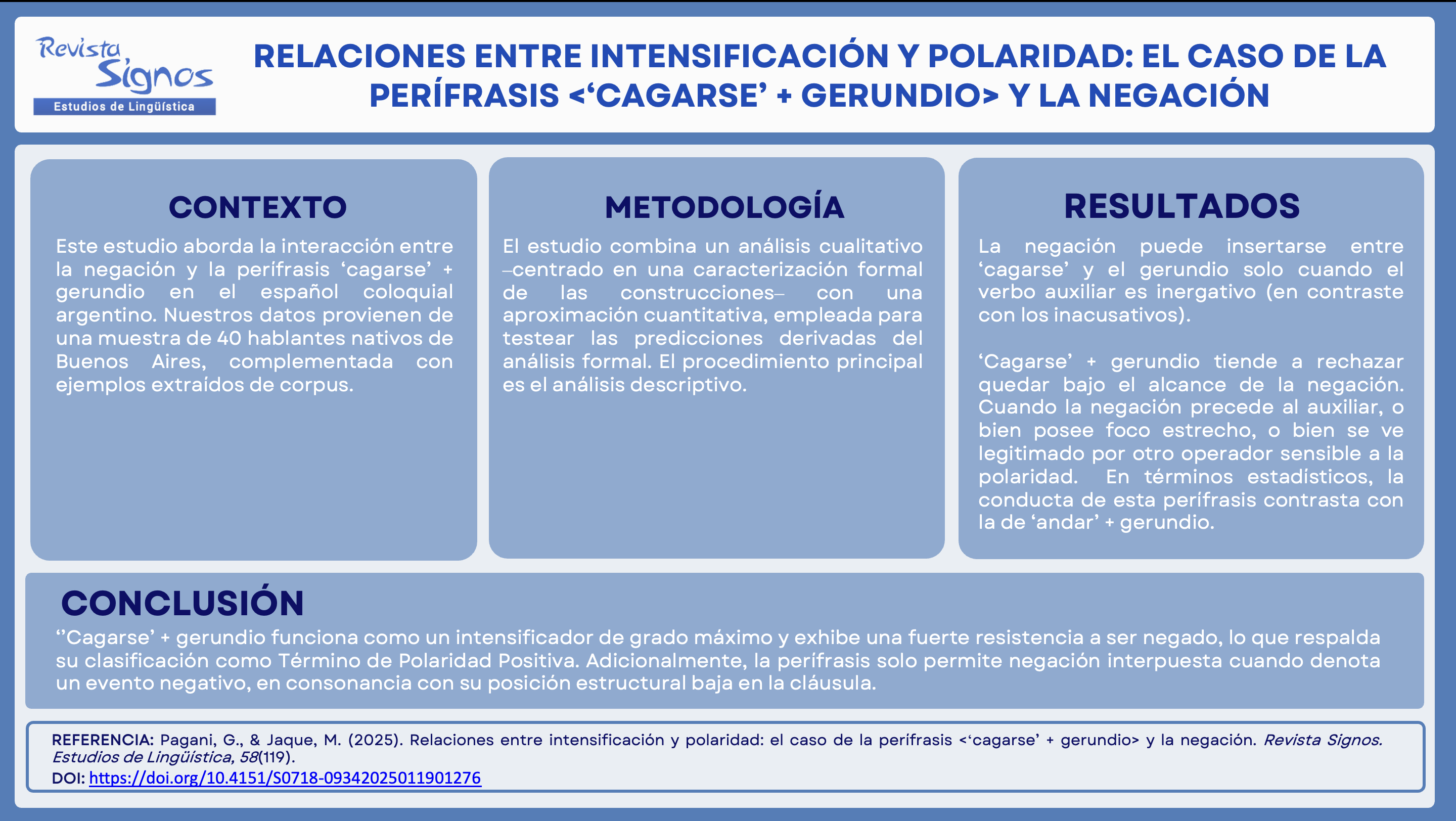
El objetivo de este trabajo es analizar la interacción entre la negación y la perífrasis <ʻcagarseʼ + gerundio> (CG), una perífrasis del español coloquial de Argentina que posee valor intensificativo. La investigación busca ampliar la caracterización sintáctico-semántica de CG ofrecida en Autor 1 (2022) al explicar las circunstancias particulares en las que a) la negación se antepone a la construcción y b) la interposición de la negación es gramatical entre auxiliar y auxiliado. Para estudiar estos contextos, se realizó una encuesta a hablantes nativos de Buenos Aires, que se complementó con una muestra controlada a partir de ejemplos tomados de corpus. Las respuestas y ejemplos obtenidos se analizaron cualitativamente y se contrastaron las hipótesis con pruebas cuantitativas. Los resultados mostraron, por un lado, que CG solo admite negaciones interpuestas cuando estas habilitan lecturas de evento negativo (Fábregas & González, 2019), lo que parece ser -leído en conjunto con otros comportamientos de CG, como su posición en cadenas de auxiliares- un indicio de la posición baja de CG en la estructura de la cláusula. Por otro lado, las diferencias encontradas entre CG y otra perífrasis no intensificadora permitirían afirmar que CG es un Término de Polaridad Positiva (TPP), que resiste, como otros elementos con valor intensificador, quedar bajo el alcance de negaciones oracionales.
Citas
Aikhenvald, A. (2011). Multi-verb constructions: setting the scene. En A. Aikhenvald y P. Muysken (Eds.), Multi-verb constructions. A view from the Americas (pp. 1-26). Leiden: Brill.
ASALE (2009). Nueva gramática de la lengua española. Espasa.
Cinque, G. & Rizzi, L. (2008). The cartography of syntactic structures. CISCL Working papers, 2, 42-58.
Cinque, G. (1999). Adverbs and Functional Heads. Oxford: Oxford UniversityPress.
Fábregas, A. & González, R. (2019). Perífrasis e inductores negativos: un análisis en términos de dominios. Onomázein, 43, 95-113. https://doi.org/10.7764/onomazein.43.10
Fernández de Castro, F. (1999). Las perífrasis verbales en el español actual. Madrid: Gredos.
Fernández Lagunilla, M. y de Miguel, E. (1999). Relaciones entre el léxico y las sintaxis: adverbios de foco y delimitadores aspectuales. Verba: Anuario galego de filoloxia, 26, 97-128.
García Fernández, L. (Dir.) (2006). Diccionario de perífrasis verbales. Madrid: Gredos.
Giammatteo, M. & Marcovecchio, A. (2010). Las perífrasis verbales del español en un enfoque léxico-sintáctico. Cuadernos de la Alfal, 1, 217-235.
Giannakidou, A. (1998). Polarity Sensitivity as (Non)Veridical Dependency. Amsterdam/Philadelphia: John Benjamins.
Gómez Torrego, L. (1999). Los verbos auxiliares. Las perífrasis verbales de infinitivo. En I. Bosque & V. Demonte (Comps.), Gramática descriptiva de la lengua española (pp. 3323-3389). Madrid: Espasa-Calpe.
González, R. (2007). Reconstruction and scope in exclamative sentences. En L. Eguren & O. Fernández-Soriano (Eds.), Coreference, modality, and focus: Studies on the syntax–semantics interface (pp. 89–112). Ámsterdam: John Benjamins.
González, R. (2008). La polaridad positiva en español. Tesis de doctorado, Universidad Complutense de Madrid, Madrid, España
González, R. (2011). Eventos negativos y perífrasis verbales. En J. Cuartero, L. García Fernández & C. Sinner (Eds.), Estudios sobre perífrasis y aspecto (pp. 9-119). München: Peniope.
González, R. (2015). Negation of resultative and progressive periphrases. Borealis, 4, 31-56.
González, R. y C. Sánchez (2022). La negación en contraste. Síntesis.
Hale, K. y S.J. Keyser (2002). Prolegomenon to a Theory of Argument Structure. MIT Press.
Haspelmath, M. (2016). The serial verb construction: Comparative concept and cross-linguistic generalizations. Language and Linguistics, 17/3, 291-319. https://doi.org/10.1177/2397002215626895
Hoeksema, J. (2018). Positive Polarity Predicates. Linguistics, 56, 2, 361-400. https://doi.org/10.1515/ling2017-0039
Homer, V. (2015). Neg-Raising and Positive Polarity: The View from Modals. Semantics and Pragmatics, 8, 4, 1-88. https://doi.org/10.3765/sp.8.4
Iatridou, S & Zeijlstra, H. (2013). Negation, Polarity, and Deontic Modals. Linguistic Inquiry. 44(4), 529-568. https://doi.org/10.1162/LING_a_00138
Köning, E. (1991). The Meaning of Focus Particles. A Comparative Perspective. Londres/ Nueva York: Routledge.
Parsons, T. (1990). Events in the Semantics of English: A Study in Subatomic Semantics. MIT Press.
Penka, D. (2016). Negation and polarity. En N. Riemer (Ed.), The Routledge Handbook of Semantics (303-319). New York: Routledge.
Quevedo García, C. (2019). Las perífrasis verbales en español: construcciones con el verbo 'acabar'. Tesis de doctorado, Universidad Complutense de Madrid, Madrid, España.
Ramchand, G. (2018). Situations and syntactic structures: Rethinking Auxiliaries and Order in English. Cambridge-Massachussets: MIT Press.
Ramchand, G. y P. Svenonious (2014). Deriving the functional hierarchy. Language Sciences 46(B), 152-174.
Sánchez, C. (1999). Los cuantificadores. Clases de cuantificadores y estructuras cuantificativas. En I. Bosque & V. Demonte (Comps.), Gramática descriptiva de la lengua española (pp. 1025-1128). Madrid: Espasa-Calpe.
Sciutto. E. (2019, noviembre). Construcciones de gerundio e intensificación de eventos en el español de Argentina [Ponencia]. I Congreso Nacional del Español Argentino, Universidad Nacional de Río Negro, Argentina.
Sciutto. E. (2020, febrero) Construcciones de gerundio, intensificación y estructura temática. [Presentación]. IV Escuela de Lingüística de Buenos Aires, Centro Interdisciplinario de Investigaciones en Psicología Matemática y Experimental, Buenos Aires, Argentina.
Szabolcsi, A. (2004). Positive polarity, negative polarity. Natural Language & Linguistic Theory. 22(2), 409-452. https://doi.org/10.1023/B:NALA.0000015791.00288.43
Tubau, S. (2020). Maximizers and minimizers as different types of polarity items. En V. Déprez & M. T. Espinal (Eds.), The Oxford Handbook of Negation (pp. 407-425). Oxford: Oxford University Press.
Wiltschko, M. (2014). The universal structure of categories. Cambridge: Cambridge University Press.
Zwarts, F. 1995. Nonveridical Contexts. Linguistic Analysis, 25(3–4), 286–312.
Publicado
Cómo citar
Número
Sección
Licencia
Derechos de autor 2025 Revista Signos. Estudios de Lingüística

Esta obra está bajo una licencia internacional Creative Commons Atribución 4.0.
Aquellos autores que tengan publicaciones con esta revista, aceptan los términos siguientes:
- Los autores conservarán sus derechos de autor y garantizarán a la revista el derecho de primera publicación de su obra por medio de este documento de cesión de derechos de autoría, el cuál estará simultáneamente sujeto a la licencia de reconocimiento de Creative Commons que permite a terceros compartir la obra siempre que se indique su autor y su primera publicación esta revista.
- Los autores podrán adoptar otros acuerdos de licencia no exclusiva de distribución de la versión de la obra publicada (p. ej.: depositarla en un repositorio institucional o publicarla en un volumen monográfico) siempre que se indique la publicación inicial en esta revista.
- Se permite y recomienda a los autores difundir su obra a través de Internet (p. ej.: en publicaciones institucionales o en su página web) antes y durante el proceso de envío, lo cual puede producir intercambios interesantes y aumentar las citas de la obra publicada. (Véase el efecto del acceso abierto).