
Gendered discourses in Twitter, Mexico City
A corpus-based study
DOI:
https://doi.org/10.4151/S0718-09342025011901314Keywords:
Corpus linguistics, language and gender, social mediaAbstract
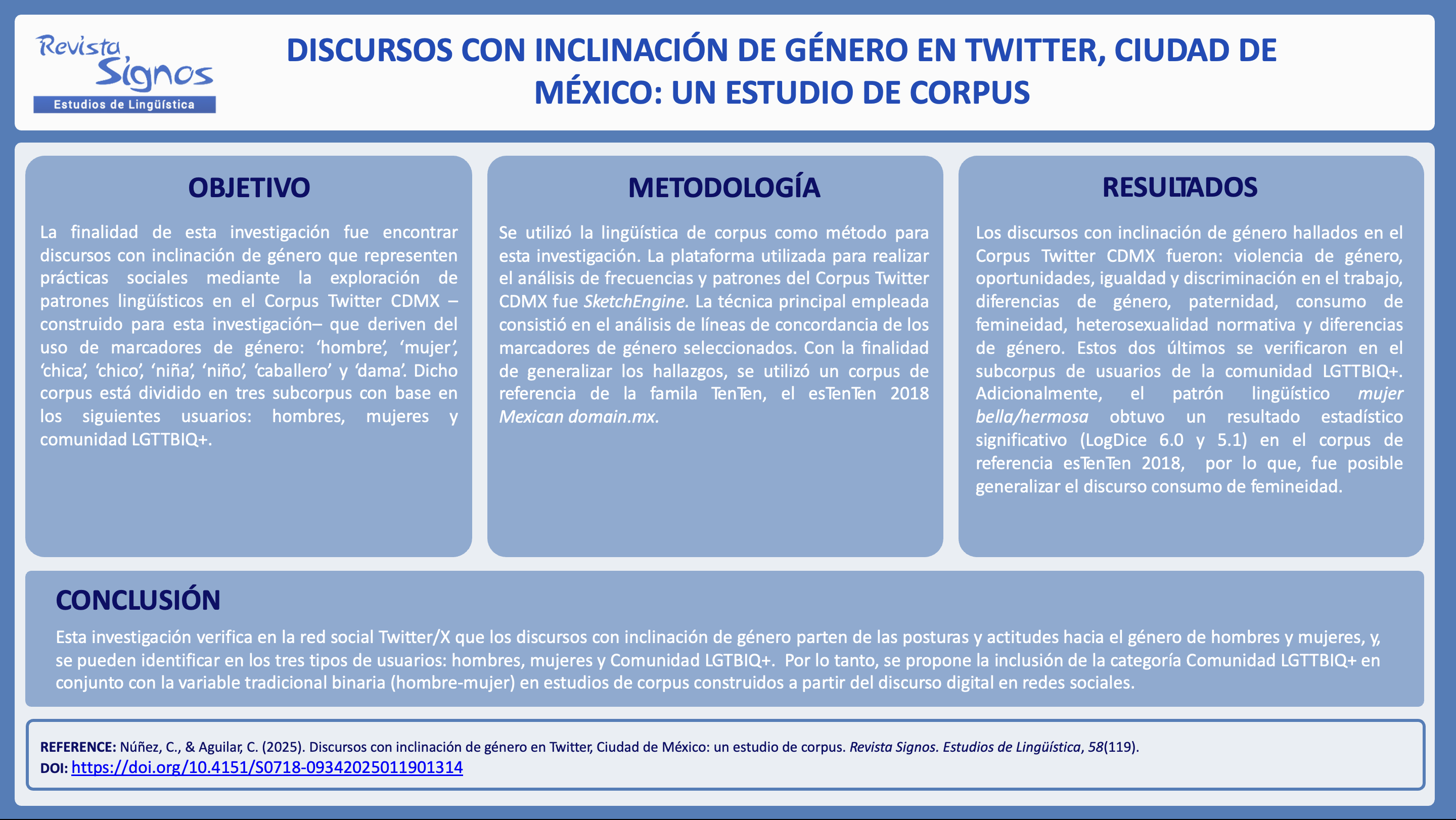
Gendered discourses are still relevant to the field of study addressing language and gender. Many studies have been conducted to analyse this type of discourses in their written and oral dimensions. However, there is a gap in the literature when it comes to their digital dimension. In this sense, this corpus-based study, using a pilot corpus (Corpus Twitter CDMX), seeks to explore language patters produced in Twitter (now X) in order to identify frequencies verifying gendered discourses in social media. So as to generalize the data, the esTenTen2018 Mexican domain .mx, was used as a reference corpus. Findings suggest that different classifications of gendered discourses are in fact present in Twitter, such as gender differences, gender violence, employment opportunities, fatherhood, and compulsory heterosexuality. Additionally, discourses of femininity consumption were found in adjective-noun the language pattern beautiful women, co-occurrence which scored the highest statistical significance (LogDice 6.0 and 5.1).
Published
How to Cite
Issue
Section
License
Copyright (c) 2025 Revista Signos. Estudios de Lingüística

This work is licensed under a Creative Commons Attribution 4.0 International License.
Copyright agreement:
Authors who have a manuscript accepted for publication in this journal agree to the following terms:
Authors will retain their copyright and grant the journal the right of first publication of their work by means of this copyright agreement document, which is subject to the Creative Commons Acknowledgment License that allows third parties to share the work provided that its author and first publication in this journal are indicated.
Authors may adopt other non-exclusive license agreements for distribution of the published version of the work (e.g., depositing it in an institutional repository or publishing it in a monographic volume) as long as the initial publication in this journal is indicated.
Authors are allowed and encouraged to disseminate their work via the internet (e.g., in institutional publications or on their website) before and during the submission process, which can lead to interesting exchanges and increase citations of the published work (read more here).