
No me Estarías Ayudando
Progressive Periphrasis in the Conditional in Rioplatense Spanish and Causes of Enunciation
DOI:
https://doi.org/10.4151/S0718-09342025011901346Keywords:
lythote, irony, conditional, causes of enunciation, dialogic approach to argumentation and polyphonyAbstract
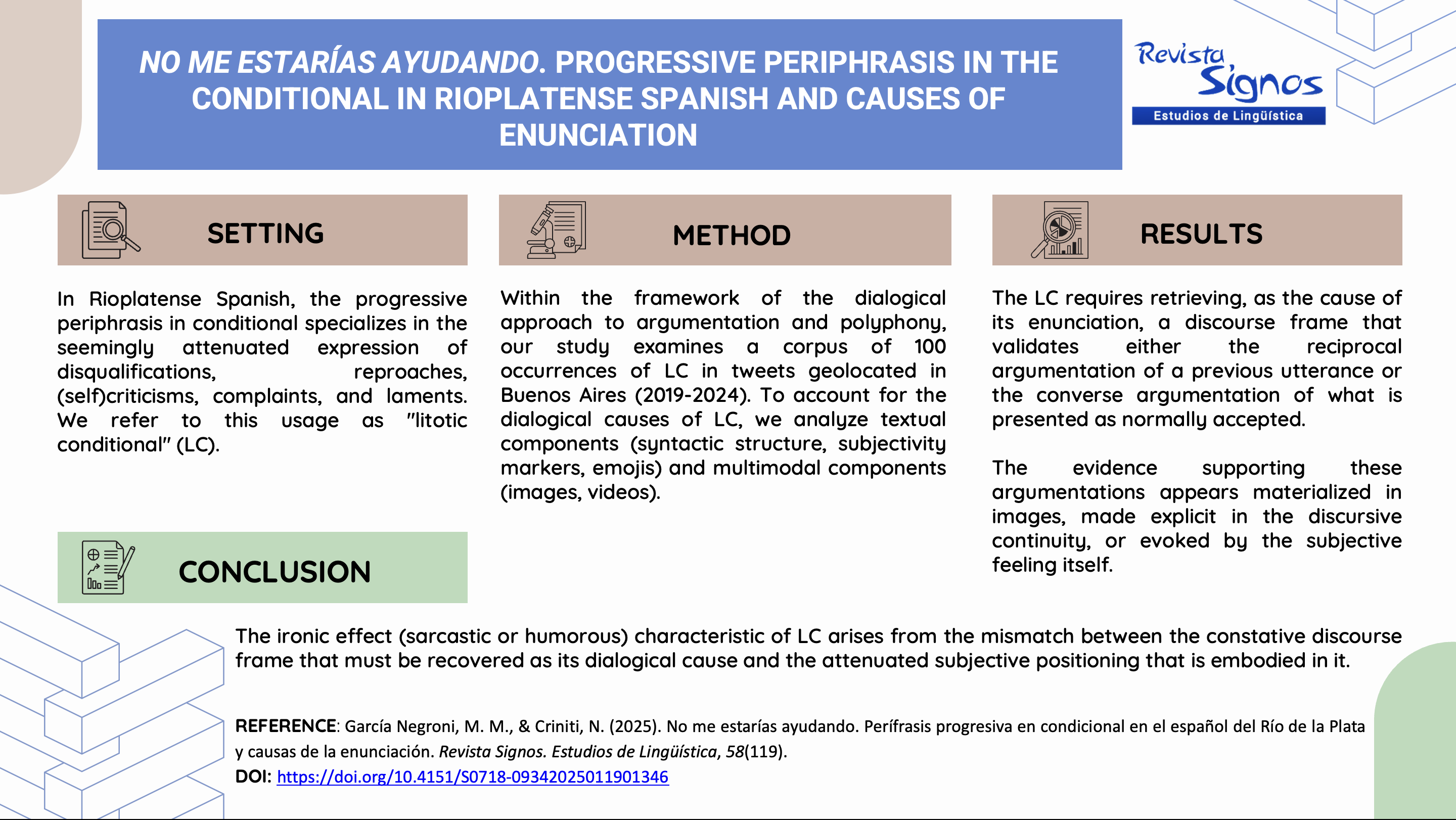
This paper analyzes the use of the conditional in the progressive periphrasis in Rio de la Plata Spanish. It is a structure that allows the feignedly attenuated expression of disqualifications, reproaches, (self-)criticisms, complaints and laments. In the light of the dialogic approach to argumentation and polyphony, the article proposes that this particular use of the conditional, which we call the “lithotic conditional” (LC), requires recovering as the dialogic cause of its enunciation a discourse framework that always alludes to strong evidence, that allows the locutor to attest to that which, although proven, appears attenuated in the enunciation. These proofs validate either the reciprocal argumentation of what has been argued in a previous discourse, or the converse argumentation of what is presented as what is normally known or accepted. As shown, it is precisely the mismatch between the constatative discourse frame to be recovered as the cause of the enunciation and the attenuated subjective positioning that is embodied in the enunciation that leads to reading this use of the conditional as lithotic, the attenuation as feigned or simulated, and the effect as ironic. The analysis is based on a corpus of 100 LC occurrences in tweets published in the last five years (2019-2024) in the social network X (formerly Twitter) and geolocated in the vicinity of the city of Buenos Aires.
Published
How to Cite
Issue
Section
License
Copyright (c) 2025 Revista Signos. Estudios de Lingüística

This work is licensed under a Creative Commons Attribution 4.0 International License.
Copyright agreement:
Authors who have a manuscript accepted for publication in this journal agree to the following terms:
Authors will retain their copyright and grant the journal the right of first publication of their work by means of this copyright agreement document, which is subject to the Creative Commons Acknowledgment License that allows third parties to share the work provided that its author and first publication in this journal are indicated.
Authors may adopt other non-exclusive license agreements for distribution of the published version of the work (e.g., depositing it in an institutional repository or publishing it in a monographic volume) as long as the initial publication in this journal is indicated.
Authors are allowed and encouraged to disseminate their work via the internet (e.g., in institutional publications or on their website) before and during the submission process, which can lead to interesting exchanges and increase citations of the published work (read more here).