
Lexical Availability and semantic networks in L1 and L2
A Systematic Review Based on the PRISMA Method
DOI:
https://doi.org/10.4151/S0718-09342025011901361Keywords:
lexical availability, semantic networks, graph theory, L1, L2Abstract
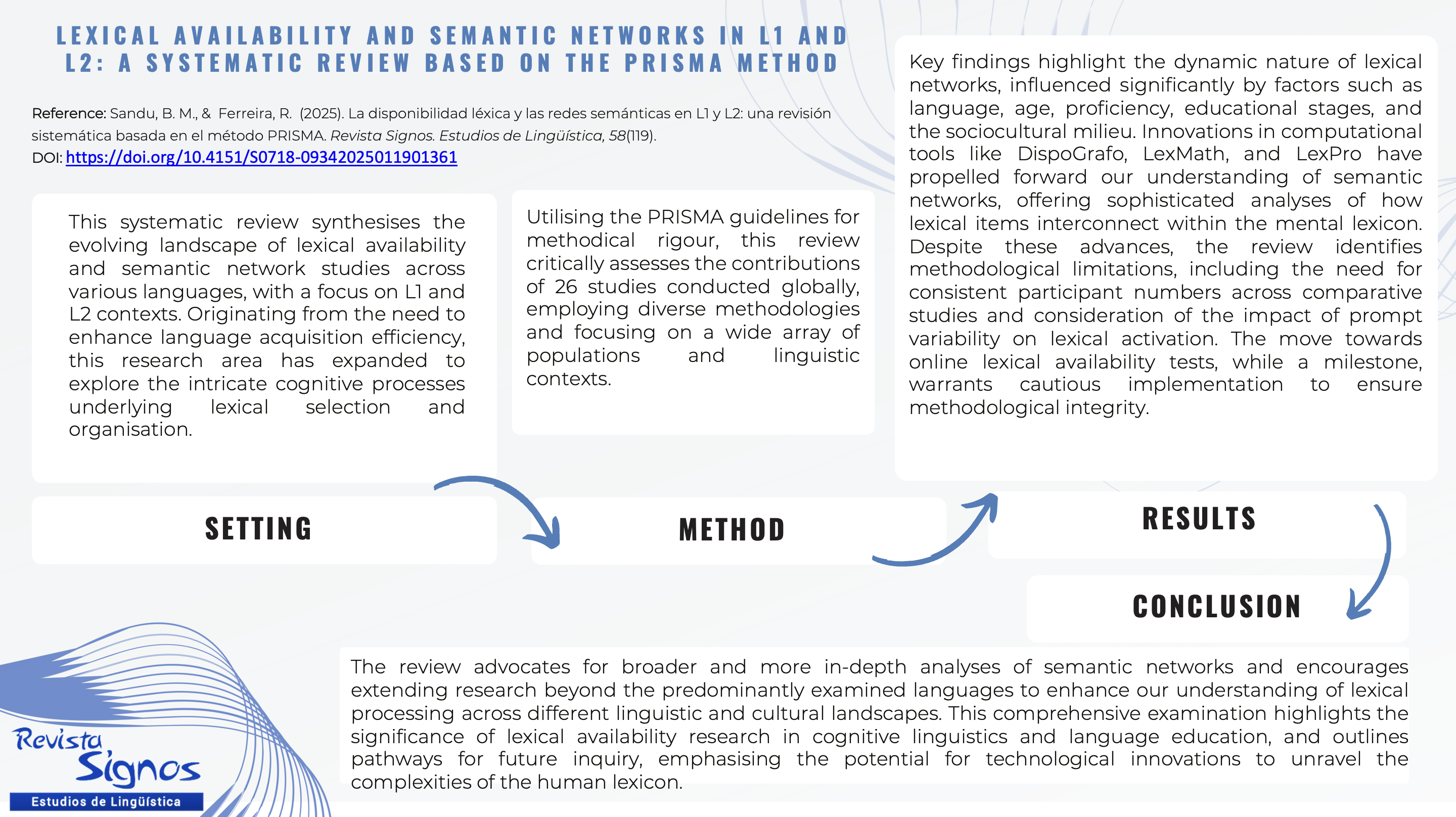
This systematic review synthesises the evolving landscape of lexical availability and semantic network studies across various languages, with a focus on L1 and L2 contexts. Originating from the need to enhance language acquisition efficiency, this research area has expanded to explore the intricate cognitive processes underlying lexical selection and organisation. Utilising the PRISMA guidelines for methodical rigour, this review critically assesses the contributions of 31 studies conducted globally, employing diverse methodologies and focusing on a wide array of populations and linguistic contexts. Key findings highlight the dynamic nature of lexical networks, influenced significantly by factors such as language, age, proficiency, educational stages, and the sociocultural milieu. Innovations in computational tools like DispoGrafo, LexMath, and LexPro have propelled forward our understanding of semantic networks, offering sophisticated analyses of how lexical items interconnect within the mental lexicon. Despite these advances, the review identifies methodological limitations, including the need for consistent participant numbers across comparative studies and consideration of the impact of prompt variability on lexical activation. The move towards online lexical availability tests, while a milestone, warrants cautious implementation to ensure methodological integrity. The review advocates for broader and more in-depth analyses of semantic networks and encourages extending research beyond the predominantly examined languages to enhance our understanding of lexical processing across different linguistic and cultural landscapes. This comprehensive examination not only highlights the significance of lexical availability research in cognitive linguistics and language education, but also outlines pathways for future inquiry, emphasising the potential for technological innovations to unravel the complexities of the human lexicon.
Downloads
Published
How to Cite
Issue
Section
License
Copyright (c) 2025 Revista Signos. Estudios de Lingüística

This work is licensed under a Creative Commons Attribution 4.0 International License.
Copyright agreement:
Authors who have a manuscript accepted for publication in this journal agree to the following terms:
Authors will retain their copyright and grant the journal the right of first publication of their work by means of this copyright agreement document, which is subject to the Creative Commons Acknowledgment License that allows third parties to share the work provided that its author and first publication in this journal are indicated.
Authors may adopt other non-exclusive license agreements for distribution of the published version of the work (e.g., depositing it in an institutional repository or publishing it in a monographic volume) as long as the initial publication in this journal is indicated.
Authors are allowed and encouraged to disseminate their work via the internet (e.g., in institutional publications or on their website) before and during the submission process, which can lead to interesting exchanges and increase citations of the published work (read more here).