
The Harassment, Persecution, and Death Threats: Appraisal of Social Behaviors in the Case of Julia Chuñil Catricura
Harassment, Persecution, and Death Threats: Appraisal of Social Behaviors in the Case of Julia Chuñil Catricura
DOI:
https://doi.org/10.4151/S0718-09342026012001434Keywords:
Valoración, mujeres indígenas, medioambiente, estudios críticos del discurso, medios digitalesAbstract
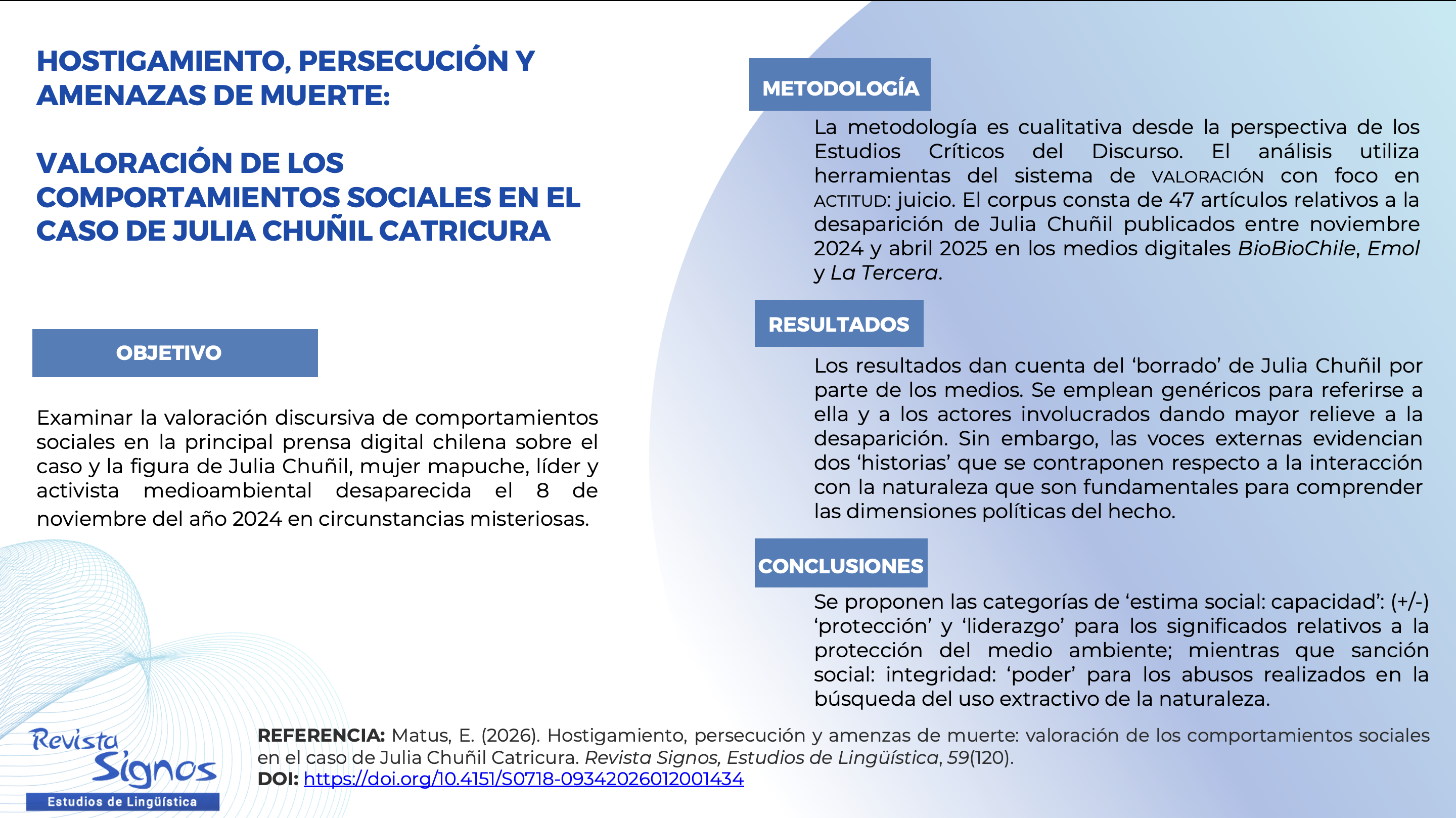
Environmental movements advocating for the nature, territory protection and “buen vivir”, driven by indigenous people are overshadowing by the economic interest of transnational extractive companies. The indigenous women play a crucial role as leaders in this environmental movement, and for this reason, they have faced persecution, harassment, and criminalization. The article examines the discursive representation in the digital media regarding the case of Julia Chuñil Catricura a Mapuche woman, leader and environmental activist who went missing in mysterious circumstances on November 8, 2024. The methodology employed is qualitative and framed within a Critical Discourse Studies perspective. The analysis utilizes the appraisal system focusing specifically on attitude: judgment. The corpus consists in 47 news articles about Julia Chuñil’s disappearance, published between November 2024 and April 2025 in the digital media press BioBioChile, Emol, and La Tercera. The findings reveal that the media often refrain from taking a stance on Julia Chuñil’s figure, referring to her only in generic terms related to her disappearance. However, external voices present in the discourse highlight various aspects of the case, allowing us to identify evaluations of ‘social esteem: capacity’ linked to the ‘protection’ of the natural environment and Julia Chuñil’s leadership. Additionally, judgments of ‘social sanction: integrity’ reveal the abuse of power surrounding her disappearance.
References
Barbosa, L. (2022). Enegrecendo os estudos críticos discursivos: contribuições epistemológicas afroperspectivistas para o campo da análise crítica do discurso no brasil. Trab. Ling. Aplic, 1(61): 251-264.
Bello, A. y Rangel, M. (2002). La equidad y la exclusión de los pueblos indígenas y afrodescendientes en América Latina y el Caribe. Revista de la Cepal 76, pp.39–54.
Comisión Interamericana de Derechos Humanos (CIDH) (2017). Las Mujeres Indígenas y sus Derechos Humanos en las Américas. Comisión Interamericana de Derechos Humanos.
Comisión Verdad Histórica y Nuevo Trato con los Pueblos Indígenas (2008). Informe de la Comisión Verdad Histórica y Nuevo Trato con los Pueblos Indígenas. Gobierno de Chile.
Contreras, M. y Oteíza, T. (en evaluación). Rol heteroglósico de los marcadores conversacionales en el diálogo: aproximación sistémico funcional.
Correa, M. y Mella, E. (2012) Las razones del illkun/enojo. Memoria despojo y criminalización en el territorio mapuche de Malleco. LOM.
Cumes, A. (2014). La India como sirvienta: servidumbre doméstica, colonialismo y patriarcado en Guatemala. Tesis para optar al grado de doctora en antropología, Centro de Estudios Superiores y Antropología Social de México.
Díaz, M. y Mellado, C. (2017). Agenda y uso de fuentes en los titulares y noticias centrales de los medios informativos chilenos. Un estudio de la prensa impresa, online, radio y televisión. Cuadernos.info (40). http://doi.org/10.7764/cdi.40.1106.
Fernández, C. (2017). La valoración en el discurso de la enseñanza de la historia. Aportes para el análisis del androcentrismo. Revista Signos. Estudios de Lingüística, 50(95), 361-384.
Fundación Escazú Ahora. (2023). 2° Informe de seguimiento Balance de la situación de los defensores ambientales en Chile durante el 2023 y análisis de la implementación del artículo 9° del Acuerdo de Escazú a más de un año de su entrada en vigencia. Fundación Escazú Ahora.
García, E. (2017). Zomo newen. Relatos de vida de mujeres mapuche en su lucha por los derechos indígenas. LOM.
Gargallo, F. (2013). Feminismos desde el Abya Yala. Ideas y proposiciones de las mujeres de 607 pueblos en nuestra América. Quimantú.
Global Witness. (2024). Missing voices. The violent erasure of land and environmental defenders. Global Witness.
Gudynas, E.(2018). Extractivismos: el concepto, sus expresiones y sus múltiples violencias. Papeles de relaciones ecosociales y cambio global, 143: 61-70.
Halliday, M.A.K.(1978/2017). El lenguaje como semiótica social. La interpretación social del lenguaje y del significado. Fondo de Cultura Económica.
Huenchumil, P. (2022) Cuerpos racializados en espacios de poder: mujeres mapuche en la Convención Constitucional y su impacto mediático. Temas Sociológicos 31: 79-106.
Kilomba, G. (2021). Memórias da plantaçao. Episódios de racismo cotidiano. Cobogó
Martin, J. y White, P. (2005). The Language of Evaluation. Palgrave Macmillan.
Millaleo, A. (2016) Ser ́nana ́ en Chile: un imaginario cruzado por género e identidad étnica. In Painemal M and Álvarez A (Comp.) (2016) Mujeres y pueblos originarios. Luchas y resistencias hacia la descolonización. CIIR Pehuén: 39-49.
Matus, E. (2024). Construção discursiva da identidade como resistência: histórias de vida de mulheres Mapuche urbanas no Chile. Revista Latinoamericana de Estudios del Discurso, RALED. 24(1). 106-124.
Mayorga, A., Nahuelpi, C., y Nitrihual, L. (2013). El imaginario social de la mujer mapuche en el discurso de la prensa en Chile. El ejemplo del diario El Austral de La Araucanía, Estudios sobre el Mensaje Periodístico 19 (2), 767-782.
Ngo, T. y Unsworth, L. (2015). Reworking the appraisal framework in ESL research: refining attitude resources. Functional Linguistics: 1-24.
Oteíza, T. (2023) Graduating points of view in Spanish written language: the role of modality. Language, Context and Text. The Sociosemiotic Forum 5.1: 163-194.
Oteíza T (2017) The appraisal framework and discourse analysis. In Barlett, T. And O’Grady, G. (eds.). The Routledge Handbook of Systemic Functional Linguistics. New York. Routledge: 457-472.
Oteíza, T, y Pinuer, C. (2019). El sistema de valoración como herramienta teórico-metodológica para el estudio social e ideológico del discurso. Logos. Revista de Lingüística, Filosofía y Literatura, 29(2), 207-229.
Pardo, L. (2019). Decolonizaçao do cohecimento nos estudos do discurso. En Resende, Viviane (comp.) Decolonizar os Estudos Críticos do Discurso (pp. 47-62), Pontes.
Pérez, C. y Solís, I. (2025). Guardianas de la Futawillimapu. Crónicas de lucha contra la intervención eléctrica. LOM
Quijano, A. (2014). Colonialidad del poder, eurocentrismo y América Latina. En Cuestiones y horizontes : de la dependencia histórico-estructural a la colonialidad/descolonialidad del poder. pp.777-832. CLACSO.
Resende, V. (2019). Perspectivas latino-americanas para decolonizar os estudos críticos do discurso. Em Resende, V . (comp.). Decolonizar os Estudos Críticos do Discurso (pp.19-46). Pontes.
Resende, V., y Veira.V. (2006). Análise de Discurso Crítica. Contexto.
Rivera-Cusicanqui, S. (2010). Ch’ixinakax utxiwa : una reflexión sobre prácticas y discursos descolonizadores. 1° ed, Tinta Limón.
Svampa, M (2019). Las fronteras del neoextractivismo en América Latina. Conflictos socioambientales, giro ecoterritorial y nuevas dependencias. México : CALAS. (Afrontar las crisis desde América Latina; 2). En Memoria Académica. Disponible en: https://www.memoria.fahce.unlp.edu.ar/libros/pm.5179/pm.5179.pdf
Vásquez-Rocca, L., Aldana, A., y Ceroni, P. (2022). Representación discursiva-multimodal de la estudiante liceana en medios digitales alternativos chilenos antes y después del estallido social, Discurso & Sociedad, 16(3); 716-744.
White, P. (2003). Beyond modality and hedging: A dialogic view of the language of Intersubjective stance. Text-Interdisciplinary Journal for the Study of Discourse, 23(2), 259–284. https://doi.org/10.1515/text.2003.011
Published
How to Cite
Issue
Section
License
Copyright (c) 2026 Revista Signos. Estudios de Lingüística

This work is licensed under a Creative Commons Attribution 4.0 International License.
Copyright agreement:
Authors who have a manuscript accepted for publication in this journal agree to the following terms:
Authors will retain their copyright and grant the journal the right of first publication of their work by means of this copyright agreement document, which is subject to the Creative Commons Acknowledgment License that allows third parties to share the work provided that its author and first publication in this journal are indicated.
Authors may adopt other non-exclusive license agreements for distribution of the published version of the work (e.g., depositing it in an institutional repository or publishing it in a monographic volume) as long as the initial publication in this journal is indicated.
Authors are allowed and encouraged to disseminate their work via the internet (e.g., in institutional publications or on their website) before and during the submission process, which can lead to interesting exchanges and increase citations of the published work (read more here).