
Polyphonic creativity in journalistic texts
DOI:
https://doi.org/10.4151/S0718-09342026012001183Keywords:
polyphonic creativity, creativity, polyphony, journalistic discourse, discourse about crimeAbstract
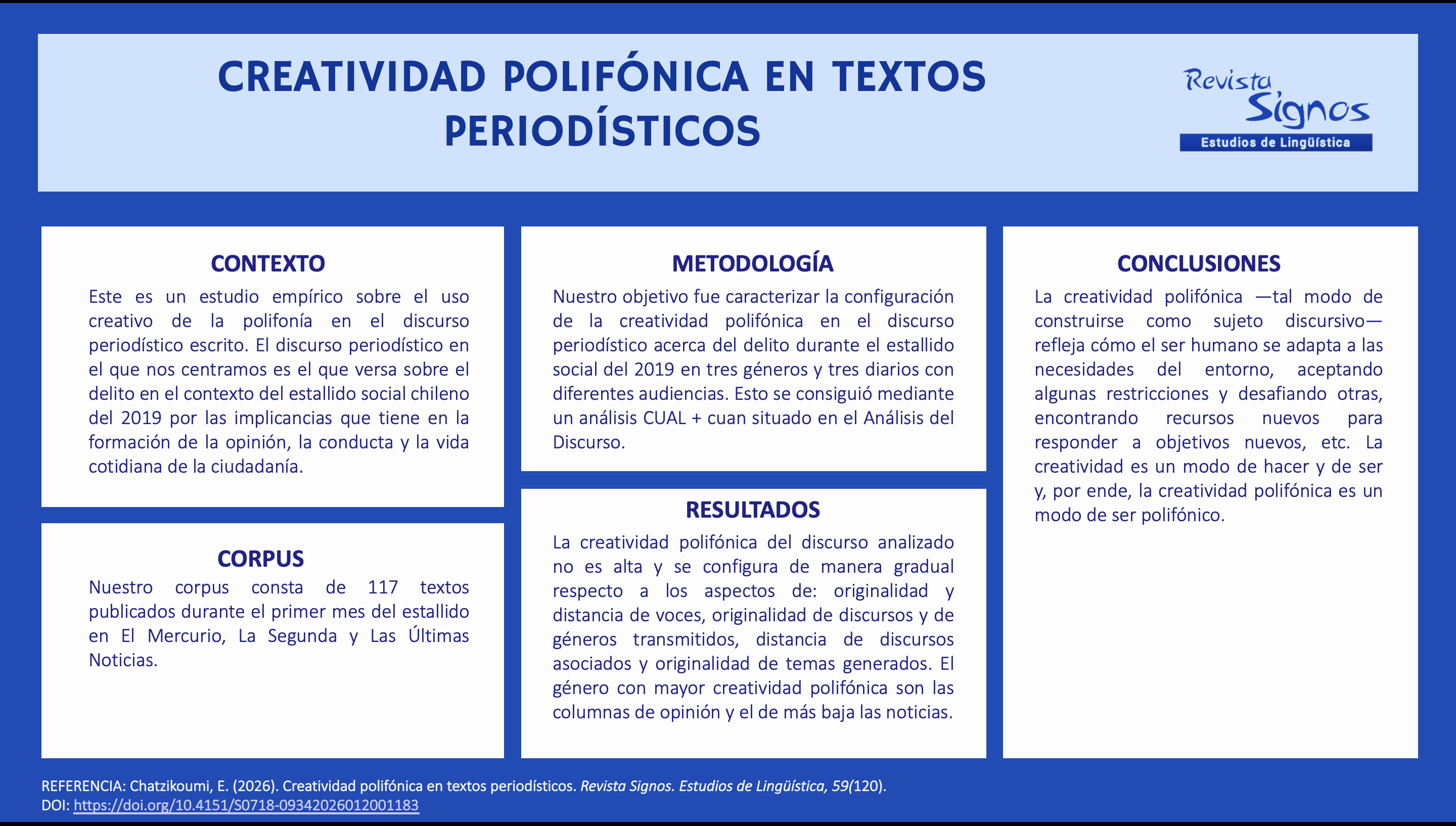
In this paper, we present an empirical study on polyphonic creativity, i.e. the creative use of polyphony, in written journalistic discourse. Creativity is a gradual phenomenon, which is present in texts but had not been studied in polyphony, a discursive phenomenon with a central role in media discourse. The journalistic discourse on which we focus is the one dealing with crime in the context of the 2019 Chilean social outbreak due to the implications it has in the shaping of opinions, the conduct and the daily life of the citizens. Our aim was to characterise the materialisation of polyphonic creativity in the journalistic discourse dealing with crime in the context of the 2019 Chilean social outbreak in three genres and three newspapers with different audiences. Thus, we performed a QUAL + quant analysis in the field of Discourse Analysis. Our corpus comprises of 117 texts published during the first month of the outbreak in El Mercurio, La Segunda and Las Últimas Noticias. We were able to determine that creativity in polyphony of the journalistic discourse we analysed is not high. The genre with the highest polyphonic creativity were the op-ed pieces and the one with the lowest, news stories. Moreover, we determined that polyphonic creativity is constituted in a gradual manner with differentiating marks in each level, in a continuum regarding the following aspects: originality of and distance between voices, originality of discourses and transmitted genres, distance between associated discourses and originality of generated topics.
Published
How to Cite
Issue
Section
License
Copyright (c) 2026 Revista Signos. Estudios de Lingüística

This work is licensed under a Creative Commons Attribution 4.0 International License.
Copyright agreement:
Authors who have a manuscript accepted for publication in this journal agree to the following terms:
Authors will retain their copyright and grant the journal the right of first publication of their work by means of this copyright agreement document, which is subject to the Creative Commons Acknowledgment License that allows third parties to share the work provided that its author and first publication in this journal are indicated.
Authors may adopt other non-exclusive license agreements for distribution of the published version of the work (e.g., depositing it in an institutional repository or publishing it in a monographic volume) as long as the initial publication in this journal is indicated.
Authors are allowed and encouraged to disseminate their work via the internet (e.g., in institutional publications or on their website) before and during the submission process, which can lead to interesting exchanges and increase citations of the published work (read more here).