
Implementation of Translanguaging in CLIL
Practices and Attitudes
DOI:
https://doi.org/10.4151/S0718-09342025011901278Keywords:
CLIL, attitude, university students, 4Cs, ChinaAbstract
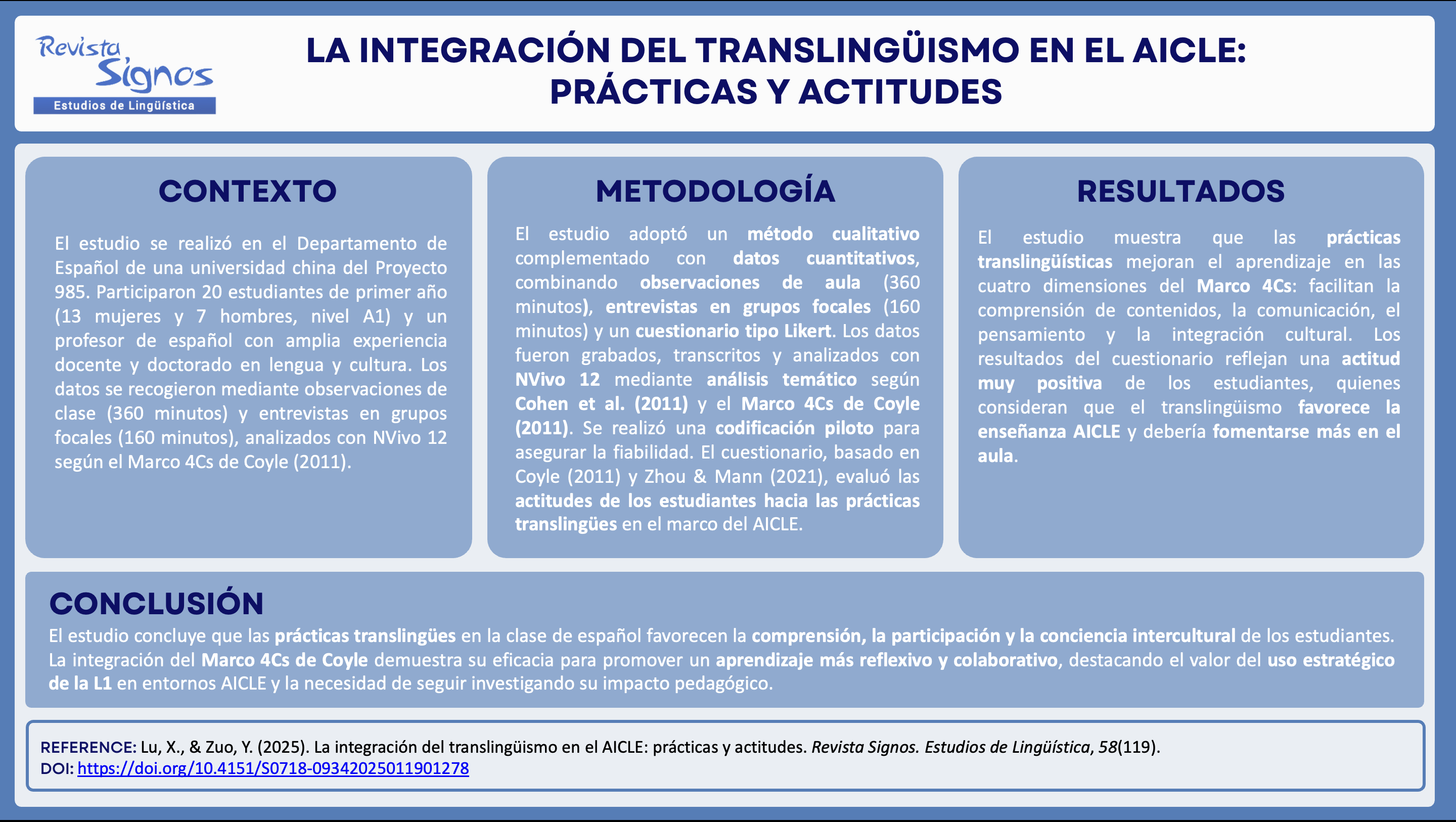
Translanguaging has gained increasing prominence within Content and Language Integrated Learning (CLIL) contexts. This study explores how translanguaging supports the holistic development of the four dimensions of the 4Cs model—content, communication, cognition, and culture—in an audio-oral Spanish course for Chinese-speaking university students. Drawing on classroom observations, questionnaire responses, and four semi-structured interviews, the research demonstartes how translanguaging facilitates the development of students’ language proficiency as well as their communicative, cognitive, and intercultural competencies. Additionally, the findings indicate that most participants hold positive attitudes towards this pedagogical approach. This study thus offers valuable insights into the effective integration of translanguaging practices in foreign language classrooms.
Published
How to Cite
Issue
Section
License
Copyright (c) 2025 Revista Signos. Estudios de Lingüística

This work is licensed under a Creative Commons Attribution 4.0 International License.
Copyright agreement:
Authors who have a manuscript accepted for publication in this journal agree to the following terms:
Authors will retain their copyright and grant the journal the right of first publication of their work by means of this copyright agreement document, which is subject to the Creative Commons Acknowledgment License that allows third parties to share the work provided that its author and first publication in this journal are indicated.
Authors may adopt other non-exclusive license agreements for distribution of the published version of the work (e.g., depositing it in an institutional repository or publishing it in a monographic volume) as long as the initial publication in this journal is indicated.
Authors are allowed and encouraged to disseminate their work via the internet (e.g., in institutional publications or on their website) before and during the submission process, which can lead to interesting exchanges and increase citations of the published work (read more here).