
Contrastive analysis of the pragmatic markers of vagueness 'es que' ('it is that') and 'en plan' ('like') in present-day colloquial Spanish
social indexicality and microhistory
DOI:
https://doi.org/10.4151/S0718-09342025011901345Keywords:
social indexicality, pragmatic markers, colloquial Spanish, microdiachronic changes, youth languageAbstract
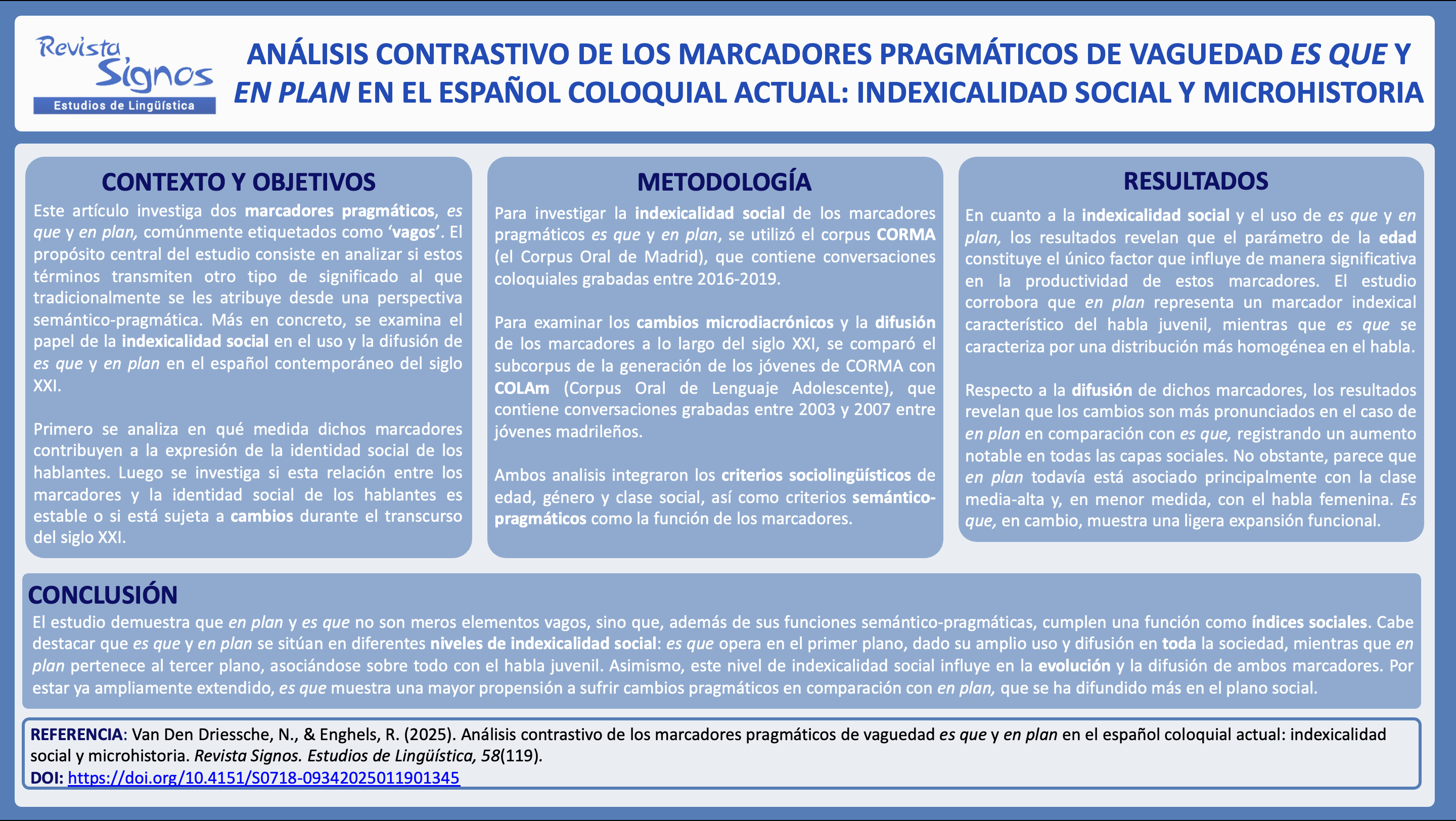
This article explores two markers of vagueness, es que (‘it is that’) and en plan (‘like’), and the role of social indexicality in their use and spread in the 21st century. Through the analysis of colloquial conversations from the CORMA corpus, it is revealed that the productivity of these markers is linked to sociolinguistic factors, particularly age. Furthermore, the findings indicate that es que and en plan occupy different levels of indexicality. While es que belongs to the first order, en plan is part of the third order, due to its emblematic status in youth language. These levels also explain differences in the dissemination of the markers. A microdiachronic analysis comparing the youth language at the beginning of the 21st century (COLAm) with current youth language (the youth sub-corpus of CORMA) reveals that third-order elements like en plan undergo faster changes and wider spread than first-order elements such as es que. Moreover, depending on the level, these links between social groups and the frequency of marker use do not always remain stable over time. Additionally, socio-cultural changes are also reflected in linguistic changes. Thus, traditional sociolinguistic parameters become less decisive in current youth language under the pressures of globalization and the expansion of social networks. Finally, the microdiachronic study indicates that the pragmatic-functional profile of both markers has remained relatively constant throughout the 21st century.
Downloads
Published
How to Cite
Issue
Section
License
Copyright (c) 2025 Revista Signos. Estudios de Lingüística

This work is licensed under a Creative Commons Attribution 4.0 International License.
Copyright agreement:
Authors who have a manuscript accepted for publication in this journal agree to the following terms:
Authors will retain their copyright and grant the journal the right of first publication of their work by means of this copyright agreement document, which is subject to the Creative Commons Acknowledgment License that allows third parties to share the work provided that its author and first publication in this journal are indicated.
Authors may adopt other non-exclusive license agreements for distribution of the published version of the work (e.g., depositing it in an institutional repository or publishing it in a monographic volume) as long as the initial publication in this journal is indicated.
Authors are allowed and encouraged to disseminate their work via the internet (e.g., in institutional publications or on their website) before and during the submission process, which can lead to interesting exchanges and increase citations of the published work (read more here).