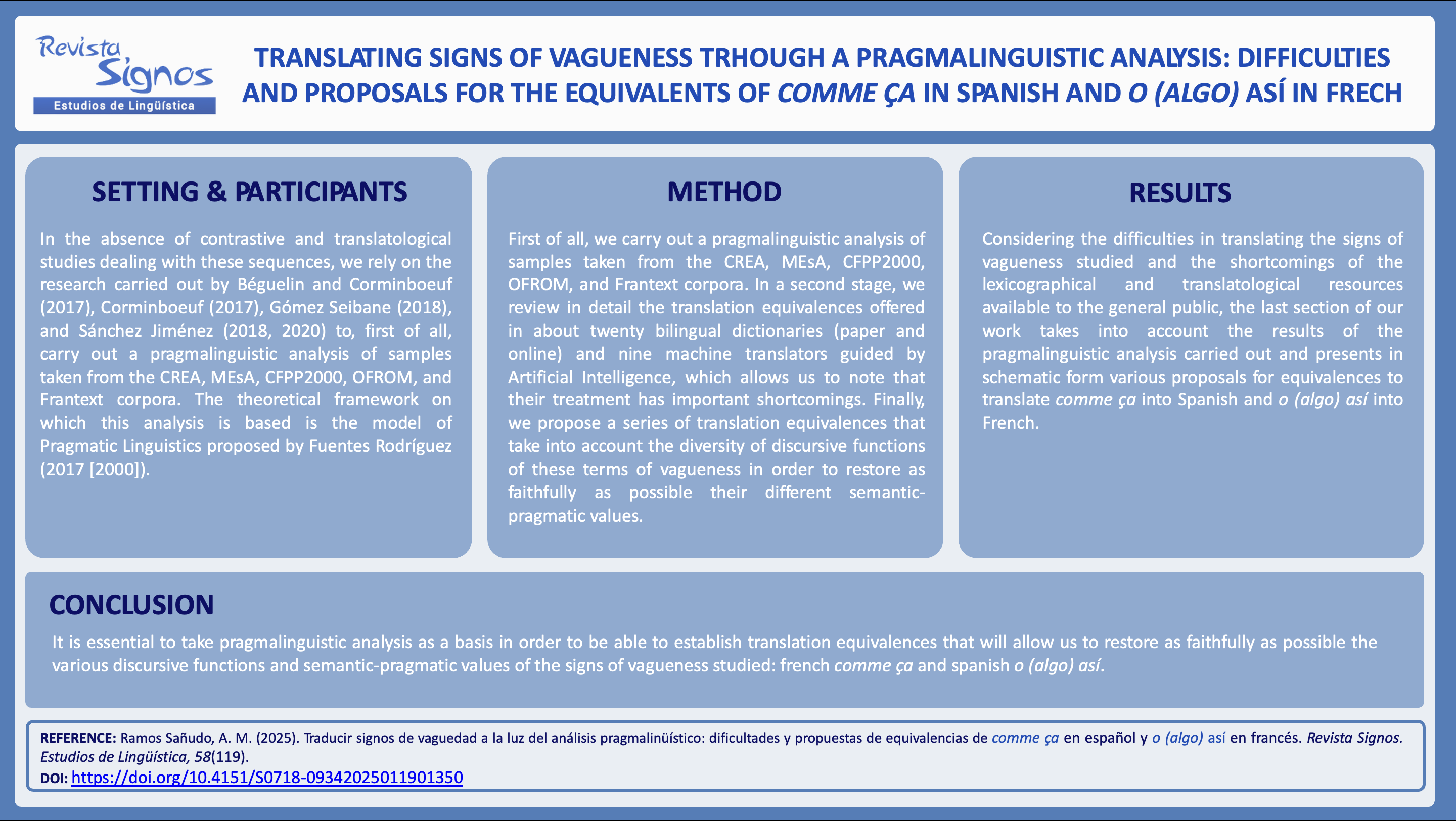
Translating signs of vagueness based on pragmalinguistic analysis
Difficulties and proposals for equivalences of 'comme ça' in Spanish and 'o (algo) así' in French
DOI:
https://doi.org/10.4151/S0718-09342025011901350Keywords:
vagueness, approximation, attenuation, reformulators, French-Spanish translationAbstract
In this paper we aim to reflect on the translation of the signs of vagueness comme ça from French into Spanish and o (algo) así from Spanish into French. Although these units have certain points in common, it can by no means be said that they are equivalent. Therefore, they cannot be translated by each other, or at least not systematically. Nor can they be translated literally - strictly word for word - or at least not in all contexts of use. In the absence of contrastive and translatological studies dealing with these sequences, we rely on the research carried out by Béguelin and Corminboeuf (2017), Corminboeuf (2017), Gómez Seibane (2018) and Sánchez Jiménez (2018, 2020) to, first of all, carry out a pragmalinguistic analysis of samples taken from the CREA, MEsA, CFPP2000, OFROM and Frantext corpora. The theoretical framework on which this analysis is based is the model of Pragmatic Linguistics proposed by Fuentes Rodríguez (2017 [2000]). In a second stage, we review in detail the translation equivalences offered in about twenty bilingual dictionaries (paper and online) and nine machine translators guided by Artificial Intelligence, which allows us to note that their treatment has important shortcomings. Finally, we propose a series of translation equivalences that take into account the diversity of discursive functions of these terms of vagueness in order to restore as faithfully as possible their different semantic-pragmatic values.
Published
How to Cite
Issue
Section
License
Copyright (c) 2025 Revista Signos. Estudios de Lingüística

This work is licensed under a Creative Commons Attribution 4.0 International License.
Copyright agreement:
Authors who have a manuscript accepted for publication in this journal agree to the following terms:
Authors will retain their copyright and grant the journal the right of first publication of their work by means of this copyright agreement document, which is subject to the Creative Commons Acknowledgment License that allows third parties to share the work provided that its author and first publication in this journal are indicated.
Authors may adopt other non-exclusive license agreements for distribution of the published version of the work (e.g., depositing it in an institutional repository or publishing it in a monographic volume) as long as the initial publication in this journal is indicated.
Authors are allowed and encouraged to disseminate their work via the internet (e.g., in institutional publications or on their website) before and during the submission process, which can lead to interesting exchanges and increase citations of the published work (read more here).