
Vagueness and Approximation
A Case Study of 'Genre' in French and 'Tipo' in Spanish
DOI:
https://doi.org/10.4151/S0718-09342025011901353Keywords:
intentional vagueness, numerical approximation, taxonomic noun, genre, tipoAbstract
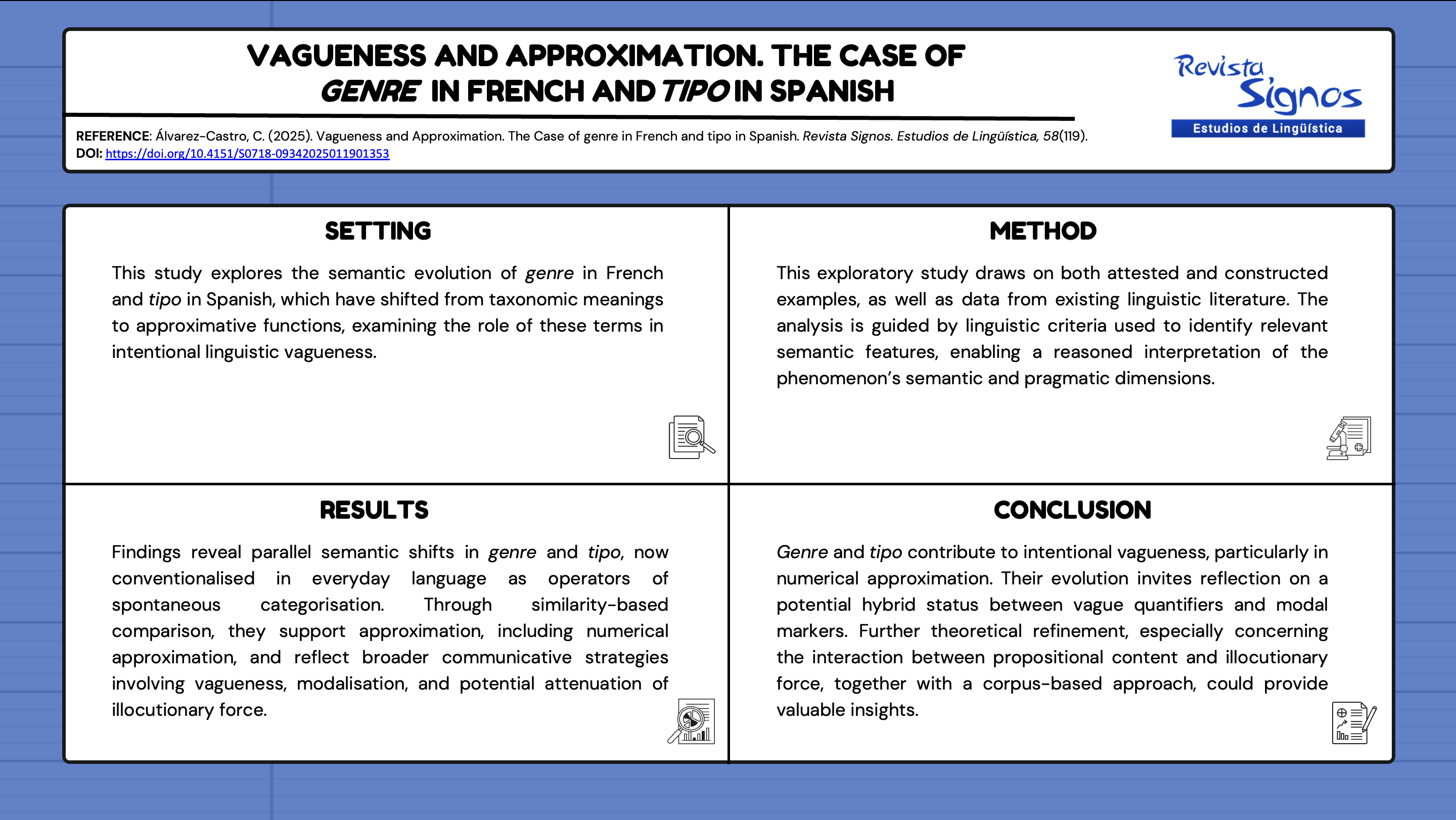
This paper investigates the phenomenon of intentional linguistic vagueness, where certain linguistic elements are used to achieve a communicative goal by placing the utterance within a spectrum of vagueness. Two such elements, genre in French and tipo in Spanish, have line gone a diachronic process of semantic change, transforming their initial taxonomic meanings into functions related to approximation. This study will first examine the evolutionary process that led to these forms adopting approximation functions. Next, it will explore the relationship between approximation and vagueness, focusing on the use of these forms to express numerical approximation. Finally, it will clarify the criteria for distinguishing vagueness, examining how genre and tipo generate a vague reading in this particular use. By applying linguistic criteria that provide verifiable results and analyzing examples, this study will test its hypotheses and provide insights into the phenomenon of intentional linguistic vagueness.
Downloads
Published
How to Cite
Issue
Section
License
Copyright (c) 2025 Revista Signos. Estudios de Lingüística

This work is licensed under a Creative Commons Attribution 4.0 International License.
Copyright agreement:
Authors who have a manuscript accepted for publication in this journal agree to the following terms:
Authors will retain their copyright and grant the journal the right of first publication of their work by means of this copyright agreement document, which is subject to the Creative Commons Acknowledgment License that allows third parties to share the work provided that its author and first publication in this journal are indicated.
Authors may adopt other non-exclusive license agreements for distribution of the published version of the work (e.g., depositing it in an institutional repository or publishing it in a monographic volume) as long as the initial publication in this journal is indicated.
Authors are allowed and encouraged to disseminate their work via the internet (e.g., in institutional publications or on their website) before and during the submission process, which can lead to interesting exchanges and increase citations of the published work (read more here).