
Receptive Vocabulary Knowledge among Chilean IB Students in Primary and Secondary Educations
Results from the Updated Vocabulary Levels Test
DOI:
https://doi.org/10.4151/S0718-09342025011901228Keywords:
receptive knowledge, vocabulary learning, frequency, International Baccalaureate programme, updated vocabulary levels testAbstract
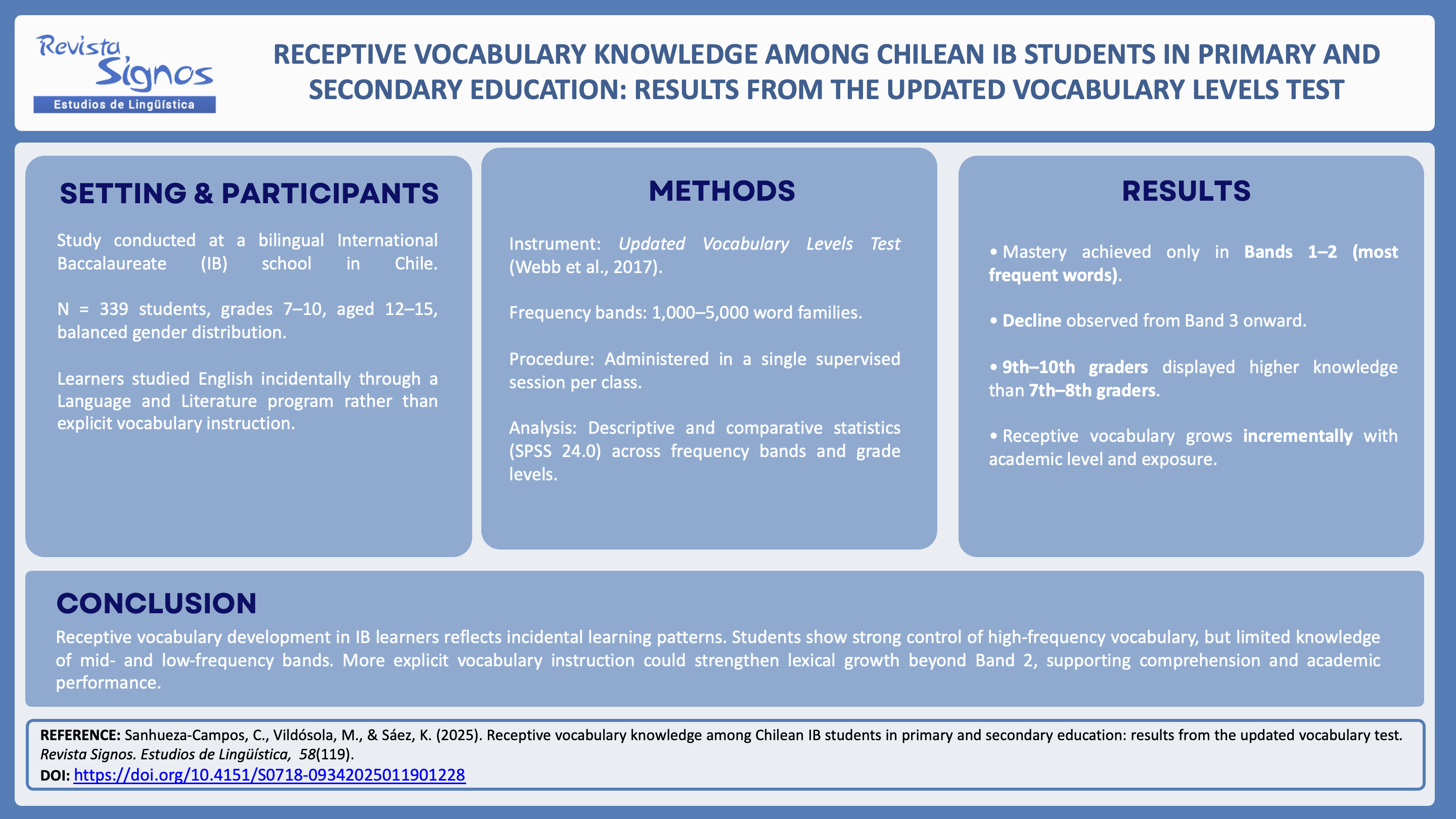
Vocabulary knowledge is regarded as the best predictor of proficiency in second language acquisition. Receptive vocabulary in International Baccalaureate (IB) institutions is learnt implicitly through a language and literature programme, as the deliberate teaching of the lexical aspect is not a priority. Thus, the main aim of this study is to ascertain the receptive vocabulary knowledge of primary and secondary school students attending an IB school by means of the updated Vocabulary Levels Test. 339 students from 7th to 10th grade were assessed with said test in a single invigilated session. This test measures knowledge of the first most frequent 5000-word families of the English language, which represent roughly more than 95% of any text. The results showed that the first 2000-word families (frequency bands 1 and 2) proved to be highly known by the participants, whereas the third 1000, the fourth 1000 and the fifth 1000-word families (frequency bands 3 to 5) need improvement. These findings align with the prevailing trend of implicit vocabulary acquisition observed in this school. Boosting vocabulary learning by a more explicit teaching approach would greatly benefit learners, especially focusing on the third, fourth and fifth frequency bands.
Downloads
Published
How to Cite
Issue
Section
License
Copyright (c) 2025 Revista Signos. Estudios de Lingüística

This work is licensed under a Creative Commons Attribution 4.0 International License.
Copyright agreement:
Authors who have a manuscript accepted for publication in this journal agree to the following terms:
Authors will retain their copyright and grant the journal the right of first publication of their work by means of this copyright agreement document, which is subject to the Creative Commons Acknowledgment License that allows third parties to share the work provided that its author and first publication in this journal are indicated.
Authors may adopt other non-exclusive license agreements for distribution of the published version of the work (e.g., depositing it in an institutional repository or publishing it in a monographic volume) as long as the initial publication in this journal is indicated.
Authors are allowed and encouraged to disseminate their work via the internet (e.g., in institutional publications or on their website) before and during the submission process, which can lead to interesting exchanges and increase citations of the published work (read more here).